


 Call Us




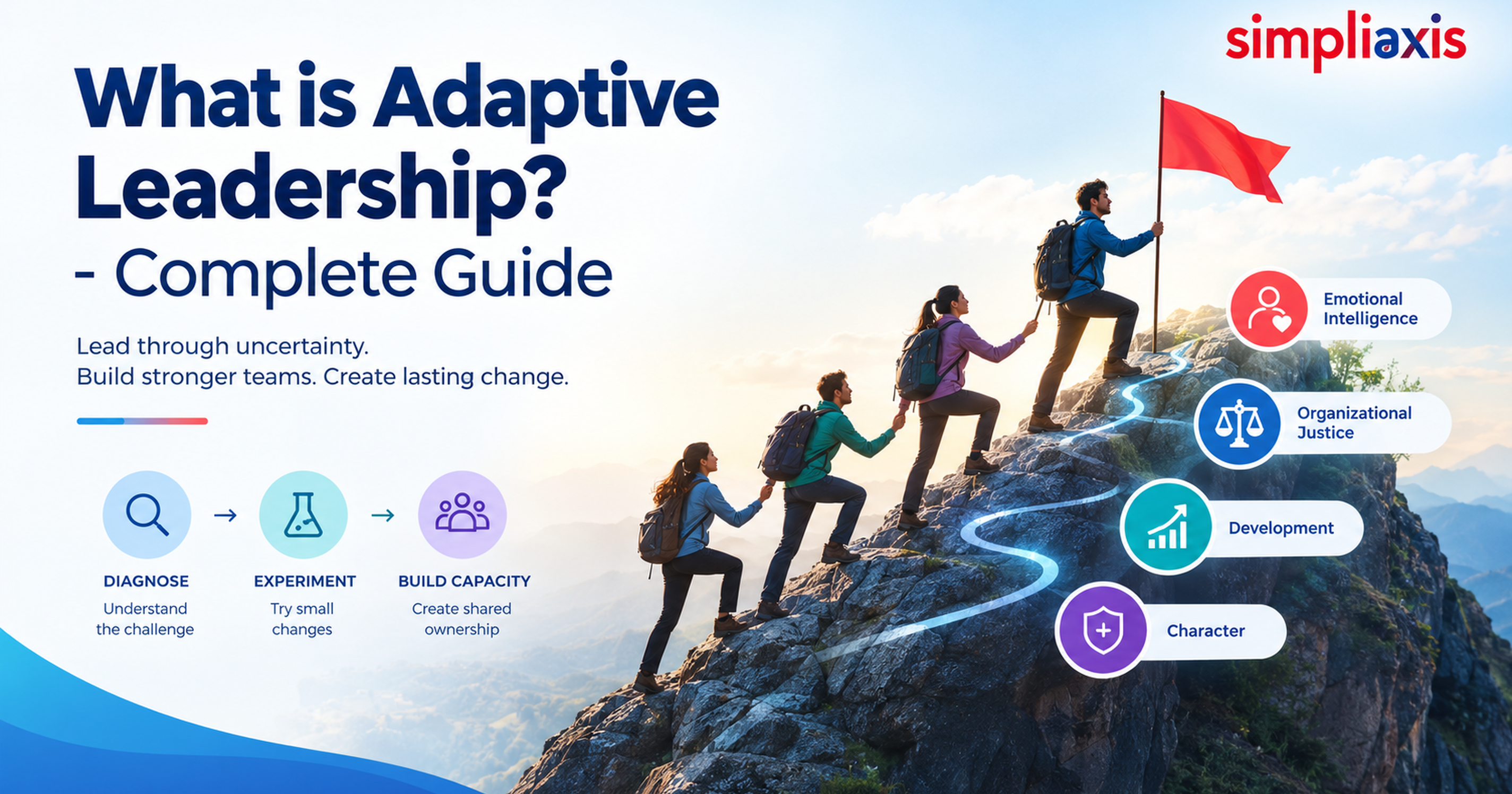
The term adaptive leadership in the context of Agile addresses how to lead a team to address the unknown. It involves analyzing the type of problems that an Agile team is facing, experimenting with small changes, and increasing the capacity of the Agile team to address the problems. This article provides the definition, a set of principles, the framework, examples, and ways to practically develop the skill.
It is important to note that plans in Agile teams are not stable. This means that Agile leaders are also not sure about the answers. In most cases, Agile leaders must use their own judgment to instruct the team to address the unknown. This type of leadership is referred to as adaptive leadership in Agile.
Key Highlights of Adaptive Leadership:
- Adaptive leadership in Agile helps leaders guide teams through problems with no ready answer. It does this through diagnosis, experiments and shared ownership.
- The model was created by Ronald Heifetz and Marty Linsky at Harvard. Its central idea is that leaders fail when they treat adaptive challenges as technical problems.
- Technical problems need expertise. Adaptive challenges need changes in habits, beliefs and roles, and most stubborn Agile problems fall into this second group.
- The four core principles are emotional intelligence, organizational justice, development and character. Together they shape how leaders treat people and act under pressure.
- Adaptive leadership works in Scrum, Kanban, SAFe and Agile ceremonies. It also overlaps with Agile and servant leadership, but each has a different focus.
- The benefits include faster response to change, higher psychological safety and stronger retros. Leaders should also expect challenges such as the need for buy-in, slower early consensus and results that are hard to measure.
What Is Adaptive Leadership?
In a nutshell, adaptive leadership is about mobilizing people in a way that they confront the toughest challenges and ultimately thrive. This requires leaders to be situationally aware, analyze the situation quickly, and learn how to guide people to change how they work.
Origin of the Concept: Ronald Heifetz and Marty Linsky, Harvard
The father of this theory is Ronald Heifetz. Marty Linsky later co-authored publications to bring the idea to the business world.
In the field of leadership, the central idea has been very popular in recent times. The main idea is that the failure of leadership is in treating adaptive challenges as if they were technical problems.
The main reason Agile leaders cite for the applicability of the model to Agile leadership is that adaptive challenges in the Agile context are mainly unfamiliar, and there are no obvious solutions. The theory provided language for the challenges.
Simple Definition in an Agile Context
Agile leadership is focused on determining how to embrace change and encourage staff to challenge the status quo, rather than exerting command and control. The leader observes, asks questions and sets direction. The staff do the real problem solving.
Think of the difference. A traditional manager assigns work. An adaptive leader forms a staff that determines the work. Sure, that is a small shift, but it creates a big behavior change, and fast.
Let’s look at an example. A team has consistently overcommitted work during a sprint and has been failing to reach the sprint goal. A traditional manager sets and enforces a task limit. An adaptive leader identifies and shares the data with the team, and acilitates a discussion about why the team keeps missing itsSprint Goaland what’s driving the pressure,the scrum master coaches the team to identify and resolve dysfunctions, while contributing positively to the group- process. and what options the team can take during the next sprint.
The Importance of Adaptive Leadership in Agile Environments
Agile embraces change. Its values favor responding to change over following a plan. Agile leadership means aligning with the team's values and practices.
VUCA and Why Traditional Leadership Fails
VUCA is volatility, uncertainty, complexity, and ambiguity. Each of these represents a different kind of pressure on a team.
- Volatility is a sudden, unexpected change.
- Uncertainty is not knowing the result of a decision
- Complexity is a system of connected parts that impact and influence each other.
- Ambiguity is vagueness, and can be interpreted in many different ways.
With VUCA, certainty rests with the individual. A leader may not know enough to make a decision. Waiting to make a decision usually leads to change.
Traditional leaders often treat all challenges as a puzzle to be solved. This style of leadership works for circumstances like a server going down. It does not work to help a team that doesn’t trust management’s product vision direction.
How Agile's iterative nature demands adaptive thinking?
Agile is based on short cycles. The goal is to create a small slice of the work, get feedback and evolve. Each cycle generates new information and challenges what was previously assumed.
A leader who views the plan as sacred resists change and stays locked to the plan, becoming a barrier to learning. An adaptive leader views each sprint as an experiment and is more receptive to change. The focus shifts from "did we follow the plan" to "what did we learn" and “what do we do next?”
When learning becomes the goal, course corrections are not only accepted but championed. Leaders provide the space for the team to be agile. Iteration becomes the way of work, and is fully supported by the leadership team.
Adaptive Leadership vs. Traditional Command-and-Control Leadership
| Dimension | Command-and-Control Leadership | Adaptive Leadership |
| Planning | Fixed plans set upfront | Iterative response to feedback |
| Decision making | Made by senior managers | Shared with people closest to the work |
| Role of the leader | Directs and monitors | Diagnoses, coaches and enables |
| View of mistakes | Failures to avoid or punish | Data for learning |
| Handling change | Change requests need approval | Change is expected and welcomed |
| Team behavior | Compliance | Ownership and initiative |
| Communication | Top-down updates | Open, two-way conversation |
| Success measure | Delivery against the plan | Value delivered and learning gained |
Technical Challenges vs. Adaptive Challenges
Heifetz and Linsky break problems down into two types. Understanding which type you are working on determines your response to it.
An example of a technical problem is correcting issues with a build pipeline that is failing. Finding the issue and implementing the solution can be difficult, but is still doable.
An adaptive challenge deals with issues of people’s beliefs, habits, loyalties, and priorities. The answer can’t be given. Only developed by the people involved.
Diagnosing Which Type You Are Facing
A good way to start is to ask some questions. They aid in sorting the problem before determining the response.
- Is a solution known? If a solution is known, it is likely technical.
- Could an expert address it? If so, it is likely technical.
- Is a change in beliefs, habits or roles required? If so, it is likely adaptive.
- Are people conflicted about what the issue even is? This is an adaptive indicator.
- Is there denial or quiet resistance? This is a good indicator of an adaptive challenge.
Resistance is also a good indicator. Emotional and political resistance indicates an adaptive challenge. If there is a lot of anxiety rather than disagreement, look deeper.
Many real world problems require both types of solution. A team might need a better way to work together (adaptive) and new tools (technical) to get their job done. Attend to the technical part of the solution as quickly as possible, then give the people part the time it deserves.
Why Agile Teams Mostly Face Adaptive Challenges?
Agile team members work on products with ill-defined requirements and with people who also bring habits, fears and other viewpoints. So Agile work largely consists of working with people and their attitudes and beliefs. Being Agile is mostly about behavior and attitudes and less about tools.
Consider the following scenarios:
- A team says it is self-organizing and yet waits for the manager to assign work.
- A stakeholder wants an immovable work deadline, and the team works in sprints
- Developers and testers are still separate and distinct.
- Leaders ask for transparency, but are negative when bad news is reported.
In all of these scenarios, a better tool is not the solution. Rather, honest dialogues, and some behavioral experiments, will bring about the required change.
Core Principles of Adaptive Leadership
Many scholars in adaptive leadership identify four principles that help develop a leader’s character: emotional intelligence, organizational justice, development and character. This serves as a base to practice. Here is how each principle shows up in the context of Agile teams.
Emotional Intelligence
Emotional intelligence is about noticing and managing your feelings and the feelings of others. The changes that come with implementing Agile can create a lot of stress and, as a leader, you need to be aware of that and help the team as best as you can.
An emotionally intelligent leader notices who stays quiet in a meeting and is calm in stressful and/or uncomfortable situations. A leader that panics teaches the team to hide problems. Calm responses build thepsychological safetyteams need to raise issues early.Leaders should recognize and reinforce the good habits of the team.
- Check in on the feelings of the people on the team at the beginning of a retrospective.
- Pause and listen to the whole statement before responding.
- Name the tension in the room.
Organizational Justice
Organizational justice, simply put, is fairness. In an Agile Team, work is evenly distributed. Credit is given to who deserved it. Decision making is transparent and includes the members of the team.
When there is a process in place and the members of the team trust it, this helps take risks and boosts the efficiency of the whole team. This is particularly useful when members of the team identify blockers. It encourages the expression of concerns of the members of the team.
Development: Coaching Over Commanding
Development means growing the skills of the people you lead. Adaptive leaders encourage learning. Instead of always providing the answers, they lead people to the answers by asking the right questions.Asking open questions instead of giving answers is a corefacilitation skill.
A coaching approach takes this form. A developer is asking for help with a blocked story. A leader suggests, “What options do you see?” or “What would you try first?” The developer ultimately needs less and less of this type of help and the team becomes stronger.
Building the team’s judgment takes time and is well worth the wait. Answering the question is a lot faster in the short term.
Character: Integrity Under Pressure
Adapting your character means you remain true to your values when things get tough, and in the case of a leader, things get very tough very quickly. Sometimes a leader is tempted to bend the truth when he or she is under pressure from a deadline, a demanding executive, or a budget cut. Team members take particular note of those situations and follow suit if they see leadership is okay with bending the truth.
A leader is trusted to keep his or her word about protecting the scope of the sprint. A leader who instills trust through a commitment to answering truthfully is trusted to be calm when the answer is not what he or she wants to hear. This is especially true for adaptive work.
Adaptive Leadership vs. Agile Leadership vs. Servant Leadership
Adaptive leadership overlaps withAgile leadership principles, but each has a different focus.
| Aspect | Adaptive Leadership | Agile Leadership | Servant Leadership |
| Core focus | Solving hard challenges that need change | Leading in line with Agile values | Serving the team's needs first |
| Origin | Heifetz and Linsky, Harvard | Agile community and the Agile Manifesto | Robert Greenleaf |
| Main question | What kind of problem is this? | How do we stay responsive and deliver value? | How can I help my team succeed? |
| Typical tools | Diagnosis, experiments, productive tension | Agile practices and ceremonies | Listening, empathy, removing obstacles |
| Best used when | Problems have no clear answer | Teams work in Agile frameworks | Teams need support and trust |
It’s also why theScrum Master is often described as a servant leader.
How Adaptive Leadership Works Within Agile Frameworks?
Each Agile framework uses leadership in unique ways. However, adaptive thinking is used in combination with all. Here is how it is integrated in the most common Agile frameworks.
In Scrum: Scrum Master and Product Owner Roles
Scrum does not provide for a traditional management role. As such, it is framework lends itself to the use of adaptive management. The scrum guide distinguishes the scrum master and product owner roles as service providers.
As such, adaptive management calls for recognition of symptoms of dysfunctions and impediments, and the Scrum Master coaches the team to resolve impediments. See the fullScrum Master roles and responsibilities.
The product owner, and by extension the scrum team must provide prioritized product backlog to the scrum team, and as such, adaptively manage expectations of stakeholders to the extent that the prioritization reflects the stakeholder value, while keeping in mind the constraints of the product.
The scrum team learns to evolve the product backlog through process adaptations. They are free to do so as scrum places no restrictions on process changes as long as product backlog items are not completed.
In Kanban: Flow-Based Adaptability
Kanban framework proposes adaptive leadership through facilitation of the work flow.Work in progress is limited throughWIP limits in Kanban, and flow is tracked visually.through aKanban board that shows where work gets stuck.
If work becomes backlogged in a column, adaptive leadership requires guiding the team to understand the cause. The work may be stuck due to a lack of a required skill, or the presence of an unrecognized dependency. It may also be stuck due to a hand off.
In Scaled Agile: Adaptive Leadership at Scale
Leading Agile transformations within enterprises requires adaptive leadership at scale. Scaling Agile adds more teams and more management layers. As dependence between those teams increases, large organizations tend to devolve into a set of teams with more management layers. Leaders can feel anxious and may revert to control, which gives them a false sense of security.
Leaders at scale focus on creating a pulling effect by setting and communicating goals. Leaders at scale do not impose solutions. Leaders at scale deal with inter-departmental conflicts. They surface and make all forms of conflicts visible.
SAFe describes this throughLean-Agile leadership, which expects leaders to coach and model behavioral change.As a leader, you are expected to coach and instill behavioral change. For more information, please contact Simpliaxis to learn about the full range of SAFe and other Agile certifications.
Role in Agile Ceremonies
There are regular meetings in Agile to help a team stay aligned. An advanced Agile leader uses these meetings to help the team learn.
- During daily stand-up meetings, listen for team members who may need your support. If someone is stalled because of a block, do not attempt to resolve the block for them.
- During sprint planning, help members set realistic objectives for the sprint, and be frank about the team’s capacity to achieve the objective.
- Participate in the discussion during the demo to help users of the product provide feedback to the product owner to help with the assessment of the product.
- Retrospective meetings are an opportunity to create a safe environment to discuss true blockers to improvement.
Sprint Retrospectivesare the most important event for an adaptive leader, because this is where learning becomes visible. Leaders who do not do follow-up on the improvement actions do not value improvement.
Key Behaviors and Characteristics of Adaptive Leaders in Agile Teams
These behaviors can be cultivated.
Observing Before Acting
As a leader, observe more and act less.
Adaptive leaders try to understand the reason for a missed goal before taking any action to resolve the situation. Leaders have to act as an enabler to the self-organizing nature of the Agile team. Leaders have to set the goals for the team and ensure the team works within the constraints.
It can be difficult to practice adaptive leadership. There are times where the options that your team comes up with can be quite slow. There is a tendency to want to jump in and give your opinion or suggestions.
However, there are times where the best thing to do is allow your team to come to those conclusions on their own, as long as they aren't going to come to an erroneous conclusion.
Tolerance of Ambiguity
There are a lot of different things that arise with being an adaptive leader. There is a fair amount of uncertainty with leadership, but as long as you are alright with not being able to give an answer right away and are comfortable with your team coming to their own conclusions and doing their own testing, it tends to work itself out in the end.
Distributed Decision Making
Decisions should be made as close to the customer as possible, and the same idea can be applied to the decisions being made within an organization.
There are a lot of options when applying an adaptive leadership style. Ultimately, the benefits tend to arise with the people within the organization and how they feel and interact with one another.
There is a greater sense of psychological safety and comfort with taking an opportunity to share a concern or potential mistake.
Overall, people feel like they are able to do meaningful work that has a direct impact on the outcomes. There is a faster recovery from a work setback, and people tend to engage more and take a greater interest in the work that they are doing.
Challenges and Limitations of Adaptive Leadership
Being forthright, there are limitations to adapting to any style of leadership, and it is important for the leader to be aware of those.
Requires Buy-In
Because there are so many levels of leadership within an organization, and because of the nature of adaptive leadership in which change is required at all levels, leaders can face impedance when higher level leaders of an organization try to assert control. This can be in the form of deflecting, or distracting, etc.
Slow Reaching Consensus
In adapting to this style of leadership, be prepared that the process to achieving consensus can be long and drawn-out. This can be very frustrating to some leaders, especially if they are under pressure to deliver. The benefit to this style of leadership is that it helps build commitment to the end goal.
Hard to Measure
Although achieving consensus can take some time, this style of leadership can be very effective in the long-term and produces the most positive, long-lasting results.
Not for All Situations
There are other styles of leadership that are more effective in achieving swift results, like in a crisis. This is not to say that the style of leadership is always wrong, merely that in some cases it is better to be direct and take control.
Real-world Examples of Adaptive Leadership in the Context of Agile
Many world renowned companies employ adaptive leadership, but their style and approach is open to change and evolution over time.
1. SPOTIFY
Spotify uses small, cross-functional teams to develop sections of the product and to determine their own methods of work. A great deal of latitude is granted to teams in pursuit of their goals.
It has been noted that Spotify’s model is evolving and changes over time. The model’s evolution is reflective of the company’s culture of adaptability and willingness to change.
2. ADOBE
In 2012, Adobe did away with its traditional performance review and replaced it with a policy of continuous feedback and evaluation, named Check-in. Managers were called to evaluate their employees without the benefit of formal structure.
While the new process took away managers’ control over performance evaluations, it provided an opportunity for managers and employees to redefine their working relationship.
3. ING
In 2015, ING, a Dutch bank, adopted Agile methodology and organized its business units into small, cross-functional teams. As with Spotify and Adobe, a willlingness to change and transform its culture was critical for success.
Using Adobe and Spotify as examples, continuous evaluation takes a back seat to culture and transforming the way employees work. The same is true for the balance ING struck with Agile.
How to Become an Adaptive Leader in an Agile Team?
- Know yourself, and know when to control your emotions, when to remain calm.
- Identify the true, underlying problem. Address this problem, truthfully and accurately.
- Apply the right amount of stress. Keep the level of stress just high enough for the team to learn and grow.
- Give the team the solution. Offer the necessary assistance and support the team requires to find the solution.
- Conduct small-scale, temporary changes. Attain a solution to an issue by experimenting for a short period of time.
- Encourage differing opinions. Allow the least dominant person to be the next speaker, and thank this person for any previous, negative comments.
- Be flexible. Modify your actions as a leader. Retrospections are a good time to do this.
- Attain and maintain knowledge. Address one, major issue the team is experiencing, and learn to apply the necessary solution to this issue.
Training may help, too. The 14-hour ICAgile Agile Leadership (ICP-LEA) course helps learn decision making and team activity and dynamics.
How to Measure the Impact of Adaptive Leadership?
| Metric | What It Shows | How to Track It |
| Team velocity trend | Stability and improvement over time | Compare sprint data across quarters |
| Delivery predictability | Planned vs. completed work | Track sprint goal success rate |
| Engagement scores | Motivation and ownership | Run short pulse surveys |
| Retro sentiment | Team mood and trust | Use simple mood votes each retro |
| Retro action completion | Follow-through on learning | Count actions finished per sprint |
| Cycle time | Speed of flow | Measure from start to done |
| Attrition and absence | Team health | Review with HR data |
Conclusion
Agile adopts an adaptive style of leadership to encompass situations whereby leaders guide their members through issues for which solutions are not readily available. This requires a leadership style that transforms a leader from being an order giver to that of an enabler. Success hinges on consistent effort.
- Adaptive leadership is a concept developed by Heifetz and Linsky.
- Solutions to technical problems are either known or can be found. Solutions to adaptive challenges involve learning and adoption of new behaviors.
Ready to build these skills? Simpliaxis offers instructor-led training for Agile leaders, Scrum practitioners and scaled Agile teams. Explore theICAgile Agile Leadership (ICP-LEA) course, theAgile and Scrum certification training or browse allprofessional certification courses. Take the next step with Simpliaxis and lead your team with more confidence.






 Lowest-Price Challenge












 Personalized Path



.webp)


 USA
 Canada
 India
 UK
 Australia
 Singapore


