


 Call Us




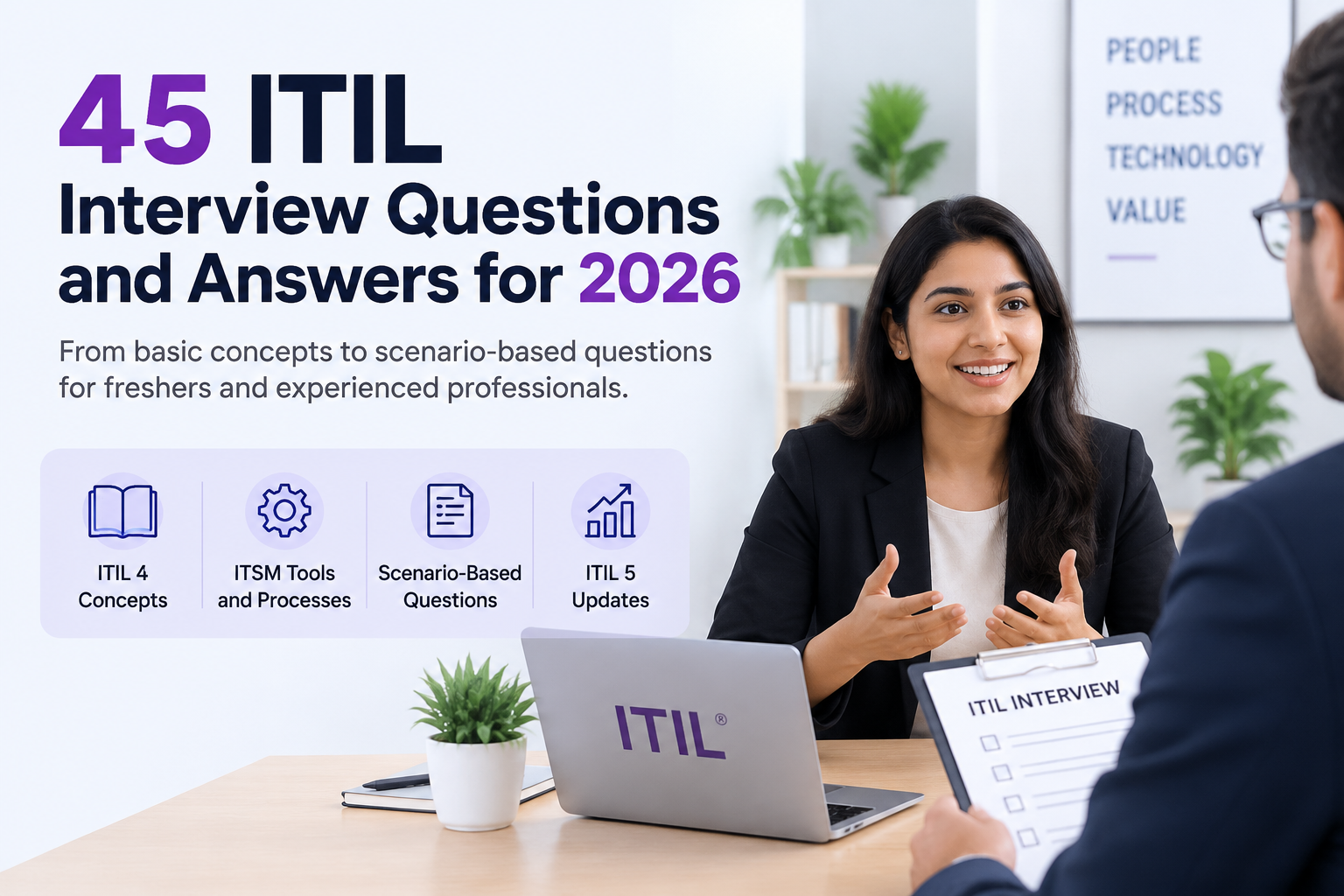
Are you a fresher, a service desk analyst, or an experienced ITSM manager? If so, you have likely faced the dread of a technical interview. The interviewer asks a simple question, and the candidate gives a textbook answer that sounds memorised. Strong candidates do something different. They define the concept in one sentence, explain why it matters, and give a short workplace example.
This guide gives you 45 ITIL interview questions and answers designed to help you move beyond textbook definitions. It covers basic ITIL concepts, ITIL 4 guiding principles, ITSM tools, incident, problem, and change management, experienced-level questions, scenario-based questions, and the changes in ITIL 5. Each answer starts with a direct response, explains why the concept matters, and includes a practical example where relevant, helping you prepare answers you can deliver confidently in an interview.
Key Highlights of ITIL Interview Questions
Short on time? Start here.
- Interviewers test understanding, not memory: Expect "why" and "what would you do" follow-ups, not just definitions.
- ITIL 4 vocabulary matters: Use terms like value co-creation, service value system, and change enablement correctly.
- Incident, problem, and change questions dominate service desk interviews: Master the differences between them.
- Scenario questions reward structure: Assess impact, restore service, communicate, then prevent recurrence.
- ITIL 5 is new: PeopleCert now positions it around digital product and service management, so be ready to explain how it relates to ITIL 4.
- Examples win interviews: One real ticket story is worth three definitions.
Section | Questions | Best for |
| Basic ITIL concepts | 1–8 | Freshers |
| ITIL 4 principles and the service value system | 9–15 | Freshers and certification candidates |
| ITSM tools and service desk | 16–20 | Service desk roles |
| Incident, problem and service request management | 21–27 | Support and operations roles |
| Change management and change enablement | 28–33 | Change analysts and managers |
| Experienced ITSM questions | 34–37 | 5+ years of experience |
| Scenario-based questions | 38–42 | All levels |
| ITIL v3, ITIL 4 and ITIL 5 | 43–45 | All levels |
Basic ITIL Interview Questions and Answers for Freshers (8 Questions)
If you are new to IT service management, these eight questions almost always open the interview. Get them right, and the rest of the conversation will feel easier.
1. What is ITIL?
ITIL sounds simple, doesn’t it? Many candidates stumble because they forget the "why." ITIL is aframework of best practices for IT service management (ITSM). It helps organisations deliver IT services that create value for their customers.
ITILstands for Information Technology Infrastructure Library. It began as a set of UK government guidelines and is now owned byPeopleCert. The current widely used version is ITIL 4, released in 2019, and ITIL Version 5 has been introduced since. ITIL does not tell you which tool to buy. It gives you guidance on how to run services, handle incidents, manage changes, and improve continually.
2. What is the difference between ITIL and ITSM?
ITSM is the discipline of designing, delivering, and supporting IT services. ITIL is one framework that guides how to do it.
Aspect | ITSM | ITIL |
| What it is | The practice or discipline | A framework of best practices |
| Scope | Any approach to managing IT services | A specific, widely adopted guide |
| Alternatives | ISO/IEC 20000, COBIT, in-house methods | None; it is itself a framework |
A simple way to say it in an interview: ITSM is the "what," and ITIL is one popular "how."For a deeper comparison, readITIL vs ITSM.
3. What is a service in ITIL?
A service is a way of enabling value co-creation by facilitating outcomes that customers want to achieve, without the customer managing specific costs and risks. In layman’s terms, the customer gets a result, and the provider handles the complexity.
For example, an email service lets employees communicate. The IT team manages the servers, licences, security, and uptime, so the business does not have to.
4. What is value co-creation?
Value co-creation implies that the provider and the customer create value together by collaborating and interacting with each other.
ITIL 4 moved a little away from the idea that providers just “deliver” value. For instance, delivers value only when the finance team uses it correctly, and the IT team supports it reliably. In short, both of the sides contribute to create value.
5. What are utility and warranty?
Utility and warranty are the two words and the two halves of every service. Utility is what the service does (fit for purpose), whereas warranty is how well it performs (fit for use).
- Utility: Does the service offer the functions the user needs?
- Warranty: Is it available, secure, and does it have enough capacity and continuity?
For instance, a reporting tool with every feature has high utility. If the tool crashes every morning at sharp 9 a.m., then we can say that its warranty is poor. Here, both utility and warranty are needed for value.
6. What is a service level agreement (SLA)?
The documented agreement between a service provider and a customer that defines the expected service level is known as a Service Level Agreement (SLA).
Typical SLA targets include response time, resolution time, availability, and support hours. For example, a P1 ticket might need a response in 15 minutes and resolution within 4 hours. An SLA should use measurable targets, so both sides know whether the commitment was met.
7. What is the difference between an SLA, an OLA and an underpinning contract?
An SLA is with the customer, whereas an OLA is between the internal teams and an underpinning contract or UC is with an external supplier.
Agreement | Between | Example |
| SLA | Provider and customer | 99.9% email availability |
| OLA (operational level agreement) | Internal teams | Network team fixes connectivity faults within 2 hours |
| UC (underpinning contract) | Provider and external vendor | Cloud vendor restores service within 1 hour |
Together, they form a chain. If an internal OLA or vendor contract is weaker than the SLA, the SLA is at risk.
8. Why do organisations adopt ITIL?
Organisations adopt ITIL to improve service quality, reduce incidents and downtime, control costs and align IT with business goals. The common benefits of adopting ITIL include:
- Consistent, repeatable ways of working
- Faster incident resolution through clear processes
- Better control of risk when changes happen
- A shared language between IT and the business
- A structured route to continual improvement
You may add a good closing line: ITIL helps IT become a reliable partner rather than a cost centre.
ITIL 4 Questions and Answers on Guiding Principles and the Service Value System (7 Questions)
Did you study forITIL 4 Foundation? If so, then these ITIL 4 questions and answers should feel familiar. Interviewers ask them to check whether you can apply the framework, not just recite it.
9. What are the 7 guiding principles of ITIL 4?
The seven guiding principles are focus on value, start where you are, progress iteratively with feedback, collaborate and promote visibility, think and work holistically, keep it simple and practical, and optimise and automate.
Principle | In practice |
| Focus on value | Ask what the customer actually needs |
| Start where you are | Reuse existing tools and processes before replacing them |
| Progress iteratively with feedback | Improve in small steps and review results |
| Collaborate and promote visibility | Share work across teams and keep it visible |
| Think and work holistically | Consider the whole service, not one team's slice |
| Keep it simple and practical | Remove steps that add no value |
| Optimise and automate | Streamline first, then automate |
These principles guide decisions in any situation. They are not steps to follow in order.
10. What are the four dimensions of service management?
The four dimensions of service management are organisations and people, information and technology, partners and suppliers, and value streams and processes.
Every service needs all four. A new ticketing tool (information and technology) will fail if staff are untrained (organisations and people). Thefour dimensions of ITIL service managementwork as a checklist, so teams do not focus only on tools while ignoring skills, suppliers or workflows.
11. What is the ITIL service value system?
The service value system (SVS) describes how all the components and activities of an organisation work together to create value.
It takes opportunity and demand as inputs and produces value as the output. Its components are the guiding principles, governance, the service value chain, practices, and continual improvement. As PeopleCert's ITIL 4 Foundation overview shows, these ideas form the core of the Foundation syllabus.
12. What is the service value chain, and what are its six activities?
The service value chain is the operating model at the heart of the SVS. It has six activities: plan, improve, engage, design and transition, obtain or build, and deliver and support.
Activity | Purpose |
| Plan | Shared understanding of vision and direction |
| Improve | Continual improvement of products, services and practices |
| Engage | Understand stakeholder needs and maintain relationships |
| Design and transition | Build services that meet expectations |
| Obtain or build | Source and create service components |
| Deliver and support | Run services and resolve issues |
Work flows through these activities in different combinations, called value streams.
13. What are ITIL 4 practices, and how many are there?
ITIL 4 defines 34 management practices, which are sets of organisational resources designed for performing work or achieving an objective. They fall into three groups:
- General management practices (14): for example, risk management and knowledge management
- Service management practices (17): for example, incident management and service desk
- Technical management practices (3): for example, deployment management
ITIL 5 has reportedly kept the 34 practices but regrouped them. Check the official PeopleCert material before quoting group names for Version 5.
14. What is the difference between an ITIL process and a practice?
The differentiation between anITIL process and a practice separates ITIL 4 candidates from ITIL v3 veterans. A process is a set of activities that turns inputs into outputs. At the same time, a practice is broader and includes processes, people, technology, and information.
In ITIL v3, the focus was on processes such as incident management. ITIL 4 widened the lens to practices, which also cover the four dimensions. So "incident management" in ITIL 4 is a practice that includes the workflow, the people, the tools, and the partners involved.
Read more:ITIL 4 vs ITIL v3
15. What is continual improvement in ITIL?
Is it a project, a team, or a mindset? The answer matters. Continual improvement is an ongoing activity that aligns services with changing business needs by identifying and acting on improvement opportunities.
It applies at every level, from a single service desk to the whole organisation. ITIL 4 supports it with the continual improvement model, which asks teams to define the vision, assess the current state, set targets, plan, act, and then check results. A simple example is reviewing monthly ticket data and automating the most repetitive request type.
ITSM Interview Questions and Answers (5 Questions)
These 5 ITSM interview questions and answers test practical knowledge. Will you recognise the tools and metrics in day-to-day work?
16. What is an ITSM tool? Give examples.
Tool questions often hide a deeper check: do you understand the process behind the screen? AnITSM toolis software that helps teams record, manage, and automate IT service work such as incidents, requests, problems, and changes.
Common examples include ServiceNow, Jira Service Management, BMC Helix, Freshservice and ManageEngine ServiceDesk Plus. A good tool supports workflows, SLA tracking, a knowledge base, a service catalogue, and reporting. Remember, ITIL is tool-neutral, so a tool supports the practice rather than replacing it.
17. What is a CMDB, and what is a configuration item?
A configuration management database (CMDB) stores information about configuration items (CIs) and the relationships between them. A CI is any component that needs to be managed to deliver a service.
CIs can include servers, laptops, applications, network devices, licences, and documents. The CMDB helps teams see impact. For example, if a database server fails, the CMDB shows which applications and business services depend on it. Its biggest risk is outdated data, so accuracy matters more than size.
18. What is a service catalogue?
A service catalogue is a structured list of the services an organisation offers, with descriptions, availability, and how to request them.
Think of it as a menu for users. It might list "New laptop request," "VPN access" and "Software installation," each with an expected fulfilment time. The CMDB, by contrast, is a technical record behind the scenes.
19. What is a service desk, and what types are there?
A service desk is the single point of contact between the service provider and its users. It handles incidents, service requests, and communication. The common structure of a service desk includes:
- Local: close to users, such as on-site support
- Centralised: one location serving the whole organisation
- Virtual: staff work from different locations using shared tools.
- Follow-the-sun: teams in different time zones hand over work for 24-hour coverage
The service desk works with definedITIL roles and responsibilities, such as incident manager and service owner, to keep ownership clear.
20. Which KPIs does a service desk track?
Common service desk KPI tracks a service desk. Moreover, it includes first contact resolution, mean time to resolve, SLA compliance, customer satisfaction, and ticket backlog.
KPI | What it tells you |
| First contact resolution (FCR) | Share of issues solved at first contact |
| Mean time to resolve (MTTR) | Average time to resolve incidents |
| SLA compliance | Percentage of tickets meeting targets |
| Customer satisfaction (CSAT) | User feedback after support |
| Reopen rate | Quality of fixes |
| Backlog | Volume of unresolved tickets |
A strong answer adds that no single KPI is enough. High speed with low satisfaction can signal rushed fixes.
ITIL Process Interview Questions: Incident, Problem and Service Request Management (7 Questions)
This is where most service desk interviews are won or lost. Can you explain the difference between an incident, a problem, and a request without hesitating? These ITIL process interview questions and ITIL incident management interview questions come up again and again.
21. What is an incident in ITIL?
An incident is an unplanned interruption to a service or a reduction in its quality.
A failed login system, a slow application, and a crashed server are all incidents. The goal of incident management is to restore normal service as quickly as possible and limit the business impact. The usual flow is logging, categorisation, prioritisation, investigation, resolution and closure, as outlined in Atlassian's incident management guide.
22. What is the difference between an incident and a problem?
An incident is a disruption that needs restoring. A problem is the underlying cause, or potential cause, of one or more incidents.
Aspect | Incident | Problem |
| Goal | Restore service fast | Find and remove the root cause |
| Focus | Symptoms | Causes |
| Urgency | Immediate | Planned investigation |
| Example | Email is down | Why does the mail server keep crashing? |
For example, restarting a server clears an incident. Investigating why it keeps failing is problem management.
23. What is a known error, and what is a workaround?
A problem that has been analysed but not yet resolved is called a known error. On the other hand, a temporary way to reduce or avoid the impact is called a workaround.
For instance, if a database lock results in a report failing every Monday, then the team may document the cause, and there is a manual restart step until a permanent fix is released. Here, the known error is the cause documented by the team, and the workaround is the manual step. Teams usually store known errors in a known error database so the service desk can resolve repeat tickets faster.
24. How is incident priority set using impact and urgency?
Priority is determined by combining impact (how many users or how much business is affected) with urgency (how quickly the issue needs resolution).
High urgency | Medium urgency | Low urgency | |
| High impact | P1 | P2 | P3 |
| Medium impact | P2 | P3 | P4 |
| Low impact | P3 | P4 | P4 |
This matrix is a common example. Organisations define their own levels. A payment gateway failure for all customers is P1. A formatting issue on one user's report is P4.
25. What is a major incident?
The incident with a significant business impact that needs a faster and more coordinated response than normal incidents is called a major incident.
Teams usually follow a dedicated procedure with:
- A major incident manager who leads the response
- A communication lead who updates stakeholders
- A bridge call or war room with the right technical experts
- A post-incident review to capture lessons
Add that clear, regular communication matters almost as much as the technical fix.
26. How does root cause analysis work in problem management?
Root cause analysis (RCA)is a structured method for identifying why an incident or problem occurred, so the underlying cause can be fixed.
Common techniques include:
- 5 Whys: keep asking "why" until the real cause appears
- Ishikawa (fishbone) diagram: group causes by category
- Pareto analysis: find the few causes behind most incidents
- Fault tree analysis: map how failures combine
For example, users lose access every week. The 5 Whys might trace it to an expiring certificate, then to a missing renewal reminder, and finally to unclear ownership.
27. What is the difference between a service request and an incident?
A service request is a formal user request for something to be provided, such as access or information. An incident is an unplanned disruption.
The following table also helps compare the three practices at once.
Practice | Purpose | Trigger | Key metric | Example |
| Incident management | Restore service quickly | Service disruption | Resolution time | VPN will not connect |
| Problem management | Remove root causes | Recurring or major incidents | Repeat incident rate | Why does the VPN keep failing? |
| Service request management | Fulfil user requests | User asks for a service | Fulfilment time | Request for new VPN access |
Service requests are usually pre-defined and low risk, so many can be automated.
ITIL Change Management Interview Questions (6 Questions)
One untested change can take down a business. That is why ITIL change management interview questions focus on risk, approvals, and judgment. Note that ITIL 4 calls this practice change enablement, though many job descriptions still say "change management."
28. What is change enablement in ITIL 4?
Change enablement is the ITIL 4 practice that maximises the number of successful IT changes by ensuring risks are properly assessed, changes are authorised, and the change schedule is managed.
The name reflects a shift in attitude. Instead of acting as a gatekeeper, the practice should enable safe and fast change. Teams often use the older label "change management" in everyday work, so it helps to mention both. Atlassian's change management guide offers a practical view of the same workflow.
29. What are standard, normal and emergency changes?
Three change types, three approval paths. Which goes where? Standard changes are low-risk and pre-authorised. Normal changes need assessment and authorisation. Emergency changes need fast approval to resolve urgent problems.
Type | Risk | Approval | Example |
| Standard | Low, well understood | Pre-approved | Installing approved software |
| Normal | Varies | Assessed and authorised by the change authority | Upgrading a database version |
| Emergency | Urgent | Expedited approval | Patching a critical vulnerability being exploited |
A good answer also notes that standard changes reduce workload, because teams do not need a full review each time.
30. What is a change advisory board (CAB)?
A group that reviews and advises on the changes that are proposed and especially higher risky once is known as Change Advisory Board (CAB).
It usually includes representatives from IT operations, development, security, and the business. In ITIL 4, the broader term is change authority, which is the person or group with authority to approve a change. A small, low-risk change might be approved by a team lead, while a major change goes to the CAB or senior management. Modern teams often keep CAB meetings for high-risk changes only.
31. What is a change freeze?
A change freeze is a period during which changes to production systems are restricted or blocked to reduce risk.
Organisations commonly use it during peak business periods, such as year-end financial closing, holiday retail seasons or major launches. Emergency changes can still proceed if the business approves them. The freeze trades speed for stability at critical times.
32. What is a post-implementation review?
A post-implementation review (PIR) evaluates whether a change achieved its objectives and identifies lessons for future changes. The review checks questions such as:
- Did the change meet its goal?
- Were there unexpected incidents?
- Did it stay within schedule and budget?
- What should the team repeat or avoid next time?
Failed or emergency changes usually deserve a PIR, and successful ones can be reviewed by sampling.
Read more:Change Management Process GuideandPhase Gate in Project Management Guide.
33. How do you assess the risk of a change?
Assess the likelihood of failure, the potential impact, and how easily the change can be reversed. A practical checklist:
- Scope: which services and users are affected?
- Complexity: how many systems or teams are involved?
- Testing: was it tested in a similar environment?
- Rollback: is there a tested back-out plan?
- Timing: does it clash with peak business hours or other changes?
- History: have similar changes failed before?
Mention that you would use the CMDB to understand dependencies, so nothing surprising breaks downstream.
ITIL Interview Questions for Experienced ITSM Professionals (4 Questions)
Have five or more years behind you? Then expect fewer definitions and more "tell me about a time" questions. These ITSM interview questions and answers reward honest, specific stories with numbers.
34. How have you implemented or improved ITIL practices in an organisation?
Anyone can list practices. Can you show results? Answer with a clear story: the problem, your action, and the measurable outcome. A strong structure:
- Situation: for example, 30% of tickets were repeat incidents.
- Action: introduced problem management, a known error database, and weekly trend reviews.
- Result: repeat incidents fell, and first contact resolution improved.
- Learning: what you would do differently.
Use only real numbers from your own experience. Interviewers can tell when figures sound invented.
35. How do you measure ITSM maturity?
Whether your service desk is beginner, intermediate, or advanced, how would you prove it? Measure ITSM maturity by assessing how consistently, measurably, and proactively practices operate, using a maturity model plus service metrics. For measuring ITSM maturity, you can combine several approaches:
- A formal maturity assessment against a model, such as ITIL-based assessments or ISO/IEC 20000 criteria
- Process KPIs, such as SLA compliance and change success rate
- Customer feedback and satisfaction scores
- Evidence of continual improvement, such as completed improvement actions
The key point is that maturity grows when practices are documented, measured, and improved, not just when tools are installed.
36. How do ITIL, Agile and DevOps work together?
ITIL, Agile, and DevOps are teammates. ITIL provides governance and service management discipline. Agile provides iterative delivery. DevOps provides collaboration and automation between development and operations.
ITIL 4 was designed to work with these approaches. For example, a DevOps team can deploy faster using automated pipelines, while change enablement keeps risk assessed through standard changes and automated checks. If you want a deeper comparison,ITIL vs Agile explains where the two approaches differ and where they overlap.
37. How do you improve first contact resolution on a service desk?
Improve FCR by giving agents better knowledge, better training, and the authority to resolve more issues at the first touch. The practical steps include:
- Build a searchable knowledge base from real tickets.
- Train agents on the most common issues
- Automate password resets and simple requests
- Improve ticket categorisation so routing is accurate.
- Review reopened tickets to find weak fixes.
Add a warning: pushing FCR too hard can make agents close tickets early, so balance it with customer satisfaction.
Scenario-Based ITIL Incident and Change Management Interview Questions (5 Questions)
These ITIL scenario-based interview questions test judgment under pressure. What would you actually do? Use a simple framework: assess, act, communicate, prevent.
38. A P1 incident hits during a change freeze. What do you do?
Treat it as a major incident and use the emergency change path if a fix needs a production change.
- Assess: confirm impact, affected services, and business risk.
- Act: engage the major incident team and prepare the fix with a rollback plan.
- Approve: get expedited emergency change approval, as the freeze policy allows.
- Communicate: update stakeholders at regular intervals.
- Review: hold a post-incident review and record lessons.
The point to make is that a freeze controls routine change, not urgent recovery.
39. The same incident recurs every week. How do you handle it?
Raise a problem record and investigate the root cause, while using a workaround to protect users.
- Link all related incidents to one problem record
- Analyse timing, logs, and recent changes
- Use a root cause technique such as the 5 Whys.
- Publish the workaround as a known error.
- Raise a change to implement the permanent fix.
Show that you go beyond closing tickets. You are reducing future ticket volume.
40. An SLA breach is about to happen on a high-priority ticket. What steps do you take?
Escalate early, make sure the right resolver has the ticket, and keep the customer informed.
- Check the ticket's priority and the remaining SLA time.
- Escalate functionally to the specialist team, or hierarchically to a manager.
- Remove blockers, such as missing access or information.
- Update the customer with clear next steps.
- If a breach is unavoidable, document the cause for review.
Mention that good SLA tools send warnings before a breach, so teams can act earlier.
41. A change you approved caused an outage. How do you respond?
Restore service first, communicate openly, and then review what the approval process missed.
- Invoke the rollback or back-out plan.
- Treat the outage as an incident and inform stakeholders.
- Preserve logs and timelines for analysis.
- Run a blameless post-implementation review.
- Update risk assessment criteria or testing requirements.
Own your role honestly. Interviewers respect candidates who focus on learning, not blame.
42. Users keep bypassing the service desk. How do you fix it?
Find out why users bypass the desk, then make the official channel easier and more valuable.
- Survey users or review feedback to learn the reasons
- Simplify ticket creation and add chat or self-service options.
- Improve response times and communication.
- Share success stories to rebuild trust.
- Work with managers to reinforce the process.
The underlying lesson is that people use the easiest route. If the service desk is slow or confusing, they will find another one.
ITIL v3, ITIL 4 and ITIL 5 Interview Questions (3 Questions)
Which version should you study? Interviewers often ask about versions to see whether you keep up with the framework.
43. What are the 5 stages of the ITIL v3 service lifecycle?
The five stages are service strategy, service design, service transition, service operation, and continual service improvement.
Stage | Focus |
| Service strategy | Decide what services to offer and why |
| Service design | Design services and supporting components |
| Service transition | Move changes into the live environment |
| Service operation | Run services day to day |
| Continual service improvement | Keep improving across all stages |
ITIL v3 was released in 2007 and updated in 2011.
44. What are the main differences between ITIL v3 and ITIL 4?
ITIL v3 is process-focused and lifecycle-based. ITIL 4 is value-focused and built around the service value system and practices.
Area | ITIL v3 | ITIL 4 |
| Structure | Five lifecycle stages | Service value system and service value chain |
| Focus | Processes | Practices and value co-creation |
| Guidance | 26 processes | 34 management practices |
| Principles | Not central | Seven guiding principles |
| Working style | Often sequential | Flexible, with Agile and DevOps in mind |
To see how ITIL 4 and the latest version compare, readITIL 4 vs ITIL 5.
45. What changes in ITIL 5?
ITIL Version 5 builds on ITIL 4 with a focus on digital product and service management, a stronger lifecycle view, and AI-native guidance.
PeopleCert positions ITIL Foundation (Version 5) around managing digital products and services across their full lifecycle, including AI-enabled environments. Based on the official certification page and published third-party analyses, the main changes include:
- A new lifecycle model: reported to replace the ITIL 4 service value chain with an eight-activity product and service lifecycle model
- An ITIL Value System: the service value system evolves, keeping guiding principles, governance, practices, and continual improvement
- AI governance: new guidance and an AI governance publication
- Continuity: the seven guiding principles and 34 management practices are reported to remain, with practices regrouped
A smart answer is balanced. ITIL 5 is an evolution of ITIL 4, not a reset, so ITIL 4 knowledge remains useful. Third-party sources report that it is being introduced alongside ITIL 4. Always confirm details on PeopleCert's website before quoting them in an interview. If you want formal Version 5 learning, explore theITIL 5 Foundation training.
How to Prepare for an ITIL Interview
Knowing the answers is only half the work. How do you deliver them with confidence? Follow this plan.
- Learn the core vocabulary. Know the service value system, guiding principles, practices, incident, problem, and change. Use ITIL 4 terms correctly.
- Prepare three real stories. Pick one incident, one problem, and one improvement from your own experience. Use the situation, action, result format.
- Practise out loud. Give each answer in 30 to 60 seconds. If you ramble, tighten the first sentence.
- Study the job description. If it mentions ServiceNow, Jira Service Management, or another tool, review its basic workflow.
- Test yourself. A realistic ITIL practice test shows weak areas quickly.
- Know the version. Be ready to explain ITIL 4 and how ITIL 5 relates to it.
- Ask one smart question. For example: "How does your team measure service improvement?"
A useful tip is to prepare for freshers and experienced questions differently. Freshers should focus on definitions and examples. Experienced candidates should focus on outcomes, trade-offs, and leadership.
Conclusion
ITIL interviews reward clarity. Define the concept in one sentence, show why it matters, and back it up with an example from real work. If you can explain the difference between an incident and a problem, walk through a change risk assessment, and handle a scenario calmly, you are ahead of most candidates.
Use these ITIL interview questions as a practice script, not a memory test. Rewrite the answers in your own words and add your own examples. If you want a recognised credential to support your preparation, the ITIL 4 Foundation certification gives you the framework knowledge interviewers expect.





 Lowest-Price Challenge












 Personalized Path



.webp)


 USA
 Canada
 India
 UK
 Australia
 Singapore


