


 Call Us



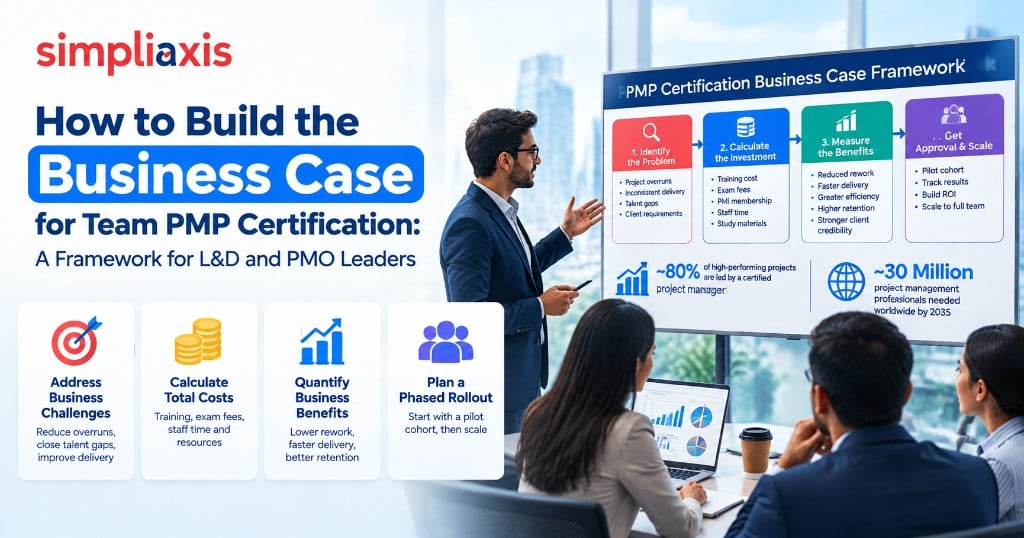
A business case for team PMP certification works when it is framed around a specific organisational cost, such as project overruns, talent gaps or inconsistent delivery methods, rather than a general claim that certification is good for staff. The strongest cases pair a documented problem with a cost model covering exam fees, training and lost working hours, then compare that against measurable benefits such as reduced rework, faster delivery and improved retention. Leadership approves training budgets when the request reads like a capital investment proposal, not a professional development request. This guide walks through the exact structure that gets team certification budgets approved.
Key Highlights of Business Case for Team PMP Certification
- A group PMP business case succeeds or fails on whether it names a specific organisational cost that certification addresses, not a generic skills gap.
- PMI's own research links certified project leadership to performance: organisations report that a large majority of high-performing projects are led by a certified project manager, a figure worth citing directly to finance stakeholders.
- Cohort or group training reduces the per-person cost of certification through bulk pricing, shared contact-hour delivery and centralised progress tracking, which materially changes the ROI maths versus individual enrolment.
- A credible cost model must include exam fees, PMI membership, training delivery, study materials and the opportunity cost of staff time away from billable or operational work.
- The benefit side of the model should separate hard financial returns (reduced rework, fewer schedule overruns) from softer but still budget-relevant returns (retention, internal promotion readiness, client credibility on proposals).
- PMI's Global Project Management Talent Gap research projects a shortfall approaching 30 million project professionals worldwide by 2035, a trend that strengthens the retention argument for training existing staff rather than only hiring certified talent externally.
- A phased rollout plan, certifying a pilot group before the full team, is usually what converts a hesitant approval into a funded, repeatable programme.
Business Case for Team PMP Certification: Why the Individual ROI Argument Does Not Work
Most PMP ROI content is written for one person deciding whether the certification is worth their own money and time. That argument does not transfer cleanly to a manager asking a finance committee to fund certification for six, twelve or thirty staff at once. An individual can justify PMP with a personal salary premium. A budget committee wants to know what the organisation gets back, not what an individual employee earns.
This distinction matters because L&D and PMO leaders who submit a business case built on salary premium statistics alone are frequently declined, not because the data is wrong, but because it answers the wrong question. Finance stakeholders are evaluating a line item against other competing requests for the same budget cycle. The case needs to show organisational cause and effect: what specific outcome improves, by how much, and over what timeframe.
A useful reframe is to treat the request the way a capital expenditure proposal is treated elsewhere in the business: state the problem, quantify the cost of the status quo, model the investment, model the return, and propose a way to test the assumption before committing the full budget.
Naming the Problem: What Certification Is Actually Fixing
Before building any cost model, identify the specific delivery problem that inconsistent project management practice is causing inside the organisation. Common, well-documented problem statements include schedule and cost overruns, inconsistent stakeholder communication across project teams, a reliance on one or two experienced project leads who cannot scale across a growing project portfolio, or a client or regulator that increasingly expects certified project leadership as a condition of doing business.
Independent research gives this problem statement real weight. A McKinsey review of troubled megaprojects found that poor execution, not external factors, was responsible for cost and time overruns in roughly 73 percent of the cases studied, with incomplete design, unclear scope and scheduling errors cited as recurring causes. That figure is worth quoting directly in a business case because it shifts the framing from "our team needs training" to "the majority of project overruns are attributable to execution discipline, which is precisely what structured certification training addresses."
On the credentialing side, industry survey data cited across multiple project management research summaries has found that a clear majority of high-performing projects, commonly cited around 80 percent, are led by a certified project manager. Cite this alongside your organisation's own recent project performance data (missed deadlines, budget variance, client escalations) so the argument is not purely external.
It is worth being precise about what these figures do and do not prove. Neither statistic demonstrates that certification alone causes better outcomes; both are correlational, and a sceptical finance reviewer will notice if the case overstates causation. The more defensible framing is that certification standardises a set of practices, structured risk analysis, defined change control, deliberate stakeholder engagement, that independently correlate with the outcomes organisations care about, and that formal training is the fastest, most measurable way to introduce those practices consistently across a whole team rather than relying on a handful of experienced individuals to model them informally.
Group PMP Training Cost: Building the Cost Model
A defensible cost model separates the direct cost of certification from the indirect cost of staff time, and it should be built per person, then multiplied across the cohort so the committee can see how the unit economics change with volume.
| Cost item | Individual enrolment (approximate) | Group or corporate enrolment (approximate) |
| PMI exam fee (member rate) | USD 445 per person, as of PMI's August 2026 fee schedule | Same PMI fee applies regardless of enrolment path |
| PMI annual membership | USD 139 to 159 per person per year | Often bundled or offset by training provider promotions for cohorts |
| Instructor-led training and 35 contact hours | USD 800 to 2,300 per person for standalone enrolment | Reduced per-seat rate when booked as a corporate cohort, commonly cited at up to 25 to 40 percent lower per person |
| Study materials, mock exams, simulators | USD 50 to 300 per person if purchased separately | Typically included in a corporate training package |
| Staff time away from billable or operational work | Variable, calculated separately below | Reduced when delivered as a single scheduled cohort rather than staggered individual leave |
The largest and most frequently omitted line item is staff time. If six project coordinators each spend 35 contact hours in training plus an estimated 60 to 100 hours of self-study, that is not a training cost, it is a labour cost, and finance will ask about it whether or not you raise it first. Calculate it as hours multiplied by the fully loaded hourly cost of each role, then present it transparently rather than letting the committee discover it and question the completeness of your model.
This is also where group and corporate training changes the calculation meaningfully rather than marginally. When an organisation books corporate and group training for an entire project team at once, the cohort trains on a single fixed schedule, the provider typically discounts per-seat pricing at volume, and the L&D or PMO lead gets a single point of contact for tracking completion and exam attempts across the whole group instead of chasing individual enrolments. That combination of lower per-seat cost and lower coordination overhead is usually the single biggest lever for improving the ROI numbers in the model.
There is a second, less obvious benefit to consolidating a cohort under one corporate training engagement rather than letting staff self-enrol individually: it becomes far easier to enforce a consistent completion timeline. Individually enrolled staff routinely delay their exam sitting by months once the initial training is over, which stalls the entire ROI timeline the business case promised leadership. A single cohort with a shared enrolment date, a shared study schedule and a named internal sponsor tracking progress produces a materially higher on-time completion rate, and that completion rate is itself worth stating as an assumption in the model, since a business case built on a cohort that never actually sits the exam delivers no return at all.
PMP Training ROI for Employers: Building the Benefit Model
The benefit side of the case should be split into two categories, because finance stakeholders weight them differently, and conflating them weakens the credibility of the whole case.
Hard, financially quantifiable benefits
These are benefits that can be tied to a dollar figure with a defensible, even if approximate, calculation method.
- Reduced rework and overrun cost. If your organisation can estimate the average cost overrun on a recent troubled project, apply a conservative improvement percentage (start with a modest 5 to 10 percent reduction assumption rather than an aggressive one, since conservative estimates are harder for finance to challenge) and multiply across the number of projects the newly certified team will lead in the next 12 months.
- Reduced reliance on external certified contractors. If the organisation currently pays a premium to bring in certified project managers or consultants for complex engagements, calculate the annualised cost of that premium and compare it to the one-time cost of certifying internal staff to the same standard.
- Retention and replacement cost avoidance. Replacing a mid-level project manager typically costs a significant multiple of that role's annual salary once recruitment, onboarding and productivity ramp-up are included. If certification is documented to correlate with retention (staff who receive employer-funded credentialing are measurably less likely to leave within the following year in most workforce research), this becomes a legitimate, quantifiable line item.
A useful supporting reference when building the retention line item is Simpliaxis's PMP certification salary guide, which documents the market premium PMP holders command. Framed correctly for a business case, that premium is not primarily an argument for what the employee gains, it is a proxy for what the organisation risks losing in replacement cost if a newly credentialed employee is not retained, and it strengthens the argument for pairing certification investment with a clear internal growth path so the training genuinely reduces turnover rather than accelerating it.
Strategic benefits that support but do not replace the financial case
Improved standardisation of project vocabulary and process across teams, stronger internal succession pipelines for PMO and programme manager roles, and increased credibility in client-facing proposals where certified staffing is a stated requirement all belong in the business case, but should be presented as supporting evidence rather than the primary justification, since they are harder to attach a number to.
Worked Example: A Twelve-Person Cohort
The table below shows how the model comes together for a hypothetical twelve-person project coordinator cohort at a mid-sized organisation. Treat the figures as a template to replace with your own numbers, not as universal benchmarks.
| Line item | Calculation basis | Approximate total |
| PMI exam fees | 12 people x USD 445 | USD 5,340 |
| Corporate group training package | 12 people x discounted per-seat rate | USD 12,000 to 18,000 |
| Staff time (study and contact hours) | 12 people x approximately 95 hours x average fully loaded hourly cost | Organisation-specific, calculate directly |
| Estimated first-year benefit (conservative) | Reduced overrun cost across the cohort's active project portfolio | Organisation-specific, typically several multiples of the training spend |
Present the return as a ratio or a break-even timeframe rather than a single inflated dollar figure. A model that shows the investment paying back within one to two completed projects is more persuasive, and more defensible under scrutiny, than one that projects benefits over an unrealistic multi-year horizon.
Corporate PMP Certification Budget Justification: Presenting the Case to Leadership
Structure the written proposal in the order a finance or executive reviewer actually reads it: problem statement first, cost of inaction second, investment required third, expected return fourth, and a phased or pilot rollout option last. Offering a pilot cohort of three to five people before committing the full team budget is frequently what gets an otherwise hesitant proposal approved, because it reduces the size of the initial financial commitment while still generating real internal data to justify scaling the programme.
Include a one-page summary table alongside the full document. Reviewers who will not read eight pages of narrative will almost always read a single table that lines up cost, benefit and payback period.
Common Objections and How to Answer Them
| Objection from leadership | How to respond |
| "We cannot verify the productivity gains will materialise." | Propose the pilot cohort structure and agree in advance on the specific project metrics that will be tracked before and after certification, so the second-phase request is backed by internal data rather than external benchmarks alone. |
| "Training budget is already allocated elsewhere this cycle." | Ask whether the request qualifies for a workforce development or training incentive outside the standard L&D budget line; several jurisdictions and states offer employer training tax credits or grants for credential-bearing programmes, though eligibility and terms vary by region and should be confirmed directly with the relevant local authority before relying on them in a budget submission. |
| "Staff will leave once they are certified." | Present retention research showing that employer-funded credentialing is more commonly associated with increased short-term retention than attrition, and pair the training commitment with a modest service agreement or staged reimbursement if the organisation's HR policy supports it. |
| "Why PMP specifically, rather than an internal programme?" | Point to PMI's Global Project Management Talent Gap research, which frames external, portable certification as a hedge against a tightening project management labour market, not just an internal skills exercise. |
Choosing How the Cohort Is Trained
Once the budget is approved, the delivery format materially affects both cost and completion rates. A single scheduled cohort trained together, rather than staff self-selecting into separate courses on their own timelines, is easier for a PMO or L&D lead to track, easier to negotiate volume pricing for, and produces a shared vocabulary across the team immediately after certification.
Reviewing a current comparison of PMP certification training providers before selecting a vendor for the cohort is worth the time investment, since accreditation status, pass-rate guarantees and post-certification support vary meaningfully between providers and directly affect whether the ROI model you presented actually holds up.
It is also worth confirming the current PMP certification cost components at the time you finalise the proposal, since PMI's exam fee has changed within the past year and stale pricing in a budget request undermines confidence in the rest of the model.
Sustaining the Programme Beyond the First Cohort
A pilot cohort proves the model works, but a genuinely sustainable programme needs a repeatable process rather than a one-off approval. Once the pilot group has certified and the tracked project metrics show a real improvement, the second and third cohorts should be easier to fund precisely because the case is no longer hypothetical. Build the reporting cadence for this into the original proposal: agree with finance up front on which two or three metrics will be reviewed at the three, six and twelve month marks after the pilot cohort certifies, so the follow-on funding request is a formality rather than a fresh negotiation.
Long term, treat certification as a standing line item tied to the organisation's project intake volume rather than an annual one-off request. New project coordinators and junior project managers who join the team should have a defined path to a PMP certification training course built into their first-year development plan, rather than certification being something only existing senior staff eventually get around to.
This is also the point at which the wider labour market context matters most for the argument: PMI's own research on the global project talent shortage projects a widening gap between the supply of qualified project professionals and organisational demand over the next decade, which means the cost of building this capability internally, on a predictable schedule, is very unlikely to fall in the years ahead.
Conclusion
A team PMP business case is approved on the strength of its cause-and-effect logic, not on the size of the individual salary premium PMP holders earn. Anchor the request to a specific, named delivery problem, build a transparent cost model that includes staff time rather than hiding it, split benefits into hard financial returns and supporting strategic returns, and offer a pilot cohort structure that lets leadership fund a smaller first step rather than a full commitment. Organisations that get this right are not just solving a training request, they are building the internal capability that PMI's own talent gap research suggests will become harder and more expensive to buy externally over the next decade.





 Lowest-Price Challenge











 Personalized Path


.webp)


 USA
USA  Canada
 India
India UK
UK Australia
 Singapore


