


 Call Us




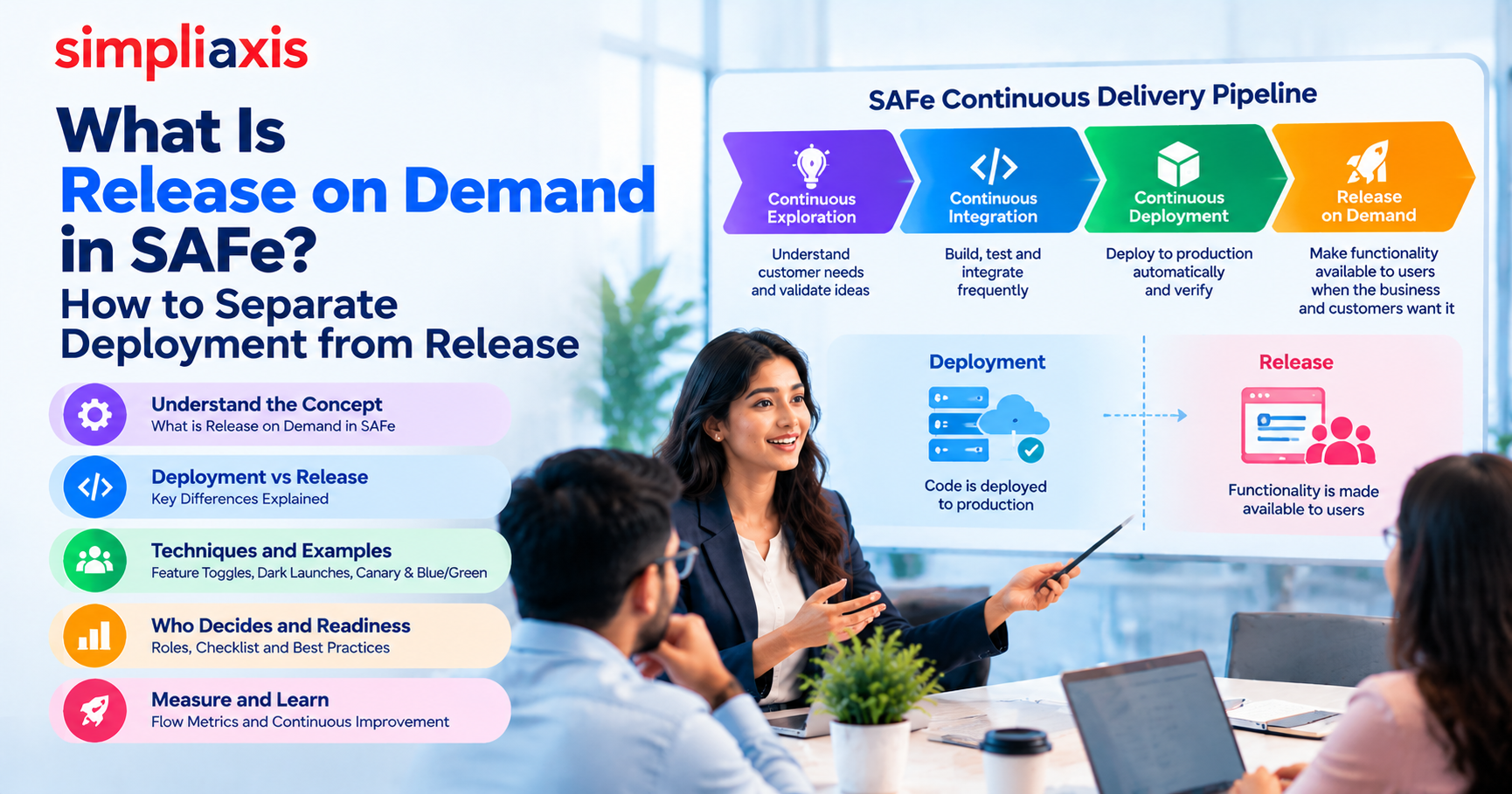
Release on Demand is the fourth and last part of the SAFe Continuous Delivery Pipeline. Its job is simple to state and hard to do well: put new functionality in front of customers at the moment the business and the customer want it, not at the moment the code happens to be finished. That only works when deploying code to production and releasing it to users are two separate decisions.
This guide explains what Release on Demand means in SAFe, how deployment differs from release, which techniques make the separation possible, who decides when to release, and what readiness looks like. It also includes a worked example, a readiness checklist and the metrics worth watching, so you can use the idea on a real release train and answer the questions that appear in SAFe DevOps and Leading SAFe classes. If SAFe itself is new to you, start with our overview of what SAFe is.
Key Highlights of Release on Demand SAFe
- Release on Demand is the fourth part of the SAFe Continuous Delivery Pipeline, after continuous exploration, continuous integration and continuous deployment.
- Deployment moves code into production. Release makes functionality available to users. SAFe treats them as separate decisions so the business can choose the timing.
- Product Management and Business Owners decide when, what and to whom to release, guided by customer needs and market timing.
- Feature toggles, dark launches, canary releases and blue/green deployment are the common techniques for separating the two.
- Release on Demand is a business and technology protocol, not only a tooling topic, and it feeds learning back into continuous exploration.
What Is Release on Demand in SAFe?
Release on Demand is the SAFe activity that decides when and how new functionality reaches customers, either all at once or in increments, based on business and customer needs. It sits at the end of the Continuous Delivery Pipeline and depends on the work done before it: exploring what to build, integrating it, and deploying it to production.
The idea is described in the SAFe Knowledge Base page on Release on Demand. A release can be a single feature or a whole product, and it can go to a specific customer segment or to everyone. Ideally features are released as soon as they are ready, but in practice many are held back until users need them or the market is ready.
Where Release on Demand sits in the Continuous Delivery Pipeline
The pipeline has four parts that run in order and feed each other. Continuous exploration decides what to build. Continuous integration builds and tests it. Continuous deployment moves it to production. Release on Demand makes it available. If you want the wider picture of how the four parts fit with the rest of the framework, our guide to why DevOps matters in SAFe is a good companion.
Release on Demand also closes the loop. After a release, the team measures outcomes and takes what it learns back into continuous exploration, which is how the pipeline tests whether a feature delivered the benefit the team expected.
Deployment vs release: the difference that matters
Traditionally, putting code into production and letting users see it were the same event. SAFe separates them, and the comparison below shows how.
| Aspect | Deployment | Release |
| What happens | Code is installed in the production environment | Functionality becomes available to users |
| Who decides | Teams and the pipeline, as part of normal flow | Product Management and Business Owners |
| Timing driver | Readiness and automation | Customer need, market timing and business strategy |
| Risk if wrong | Technical incident | Business and customer impact |
| Reversibility | Rollback or fix forward | Switch off, withdraw or limit exposure |
| Pipeline part | Continuous deployment | Release on Demand |
Once you see them as two decisions, many release problems become easier to handle. A change can sit safely in production for weeks while the business waits for a marketing date, because users never see it until someone chooses to release it.
Why Decoupling Deployment from Release Matters for Business Agility
SAFe's guidance on continuous deployment gives several reasons for the separation. Changes can reach production and be verified there without affecting what current users experience. Functionality can go to targeted customers first, so the organisation can assess impact before a full release. Experiments such as A/B tests become possible because different users can see different functionality. And small, frequent deployments become economical once builds, tests and deployments are automated.
There is a business reason too. Release timing is an economic lever. A feature that is deployed and verified weeks before a campaign can go live the moment the campaign starts, and a feature that turns out to be wrong can be pulled without a new deployment. This is what business value in SAFe looks like at the end of the pipeline: not code shipped, but value delivered at the right time.
Seen against the wider benefits of the Scaled Agile Framework, this is one of the places where faster flow turns into a visible business result. Teams that deploy rarely get the opposite effect. Releases become large, risky events with long freezes and long lists of changes, and every change is held hostage to the slowest one.
Release Techniques Compared: Feature Toggles, Dark Launches, Blue/Green and Canary
SAFe's guidance and practitioner sources list several practices that make it possible to deploy without releasing. None is mandatory, and most teams use more than one. Martin Fowler's article on feature toggles is a widely used reference for the first of these.
| Technique | How it works | Best used for | Main risk |
| Feature toggle | Code ships switched off and is turned on by configuration | Timed launches, gradual exposure, quick switch-off | Old toggles pile up and add complexity |
| Dark launch | A feature runs in production, often processing real traffic, but users cannot see it | Testing behaviour and performance under real conditions | Hidden load and cost if left running |
| Canary release | A small share of users or servers gets the change first | Limiting the damage of a bad change | Needs good monitoring to be useful |
| Blue/green deployment | Two production environments exist; traffic is switched from the old to the new | Low-downtime cutovers and fast rollback | Duplicate infrastructure cost |
| Selective release | Specific customers, regions or segments get the feature first | Pilots and customer-specific launches | Segment rules must be maintained |
Choosing between them
Start with the question the business is asking. If it is "when can we turn this on", a feature toggle fits. If it is "will this hold up under real load", a dark launch fits. If it is "how do we limit the harm of a bad change", use a canary release. If it is "how do we switch environments without downtime", use blue/green.
A practical rule is to keep toggles short-lived. Remove each one once the feature is fully released, or the codebase fills with dead branches that nobody dares to delete.
How the Four Continuous Deployment Activities Prepare for Release
Release on Demand works only if deployment is routine and trustworthy. SAFe describes four activities in continuous deployment, and each one makes a later release safer.
1. Deploy the solution to production through an automated, repeatable process.
2. Verify that the changes work in production as intended, before customers see them.
3. Monitor production and report issues as they appear.
4. Respond quickly when problems occur during or after deployment.
If any of these is weak, the business cannot release with confidence. A team that cannot verify in production will not trust a toggle. A team that cannot monitor will not notice a bad canary. Our article on features in SAFe explains how work is sized so that something can be deployed in small slices in the first place.
Who Decides When to Release in SAFe?
According to the SAFe Knowledge Base, Product Management and Business Owners decide when to release, what to release and which end users receive it. They are guided by a customer-centric view, market rhythms and roadmap milestones. Agile teams, Product Marketing, sales teams and the customers themselves are involved in different ways.
| Role | Contribution to a release decision |
| Product Management | Decides content and timing based on customer needs and the roadmap |
| Business Owners | Confirm business value, risk appetite and timing |
| Agile teams and ART | Keep the solution deployable, verified and switchable |
| Product Marketing | Plans promotion and targets the right audience |
| Sales and support | Prepare customers and handle questions |
This split of responsibilities is a small example of the SAFe dual operating system, where a hierarchy handles direction and a network of teams handles delivery. Notice that the pipeline does not decide the release. It makes the release possible. The business decides, and the teams make sure that decision can be executed without a new deployment. If you want to understand how Business Owners take part in planning, read about what Business Owners do in PI Planning.
Worked Example: Shipping a Payments Feature Weeks Before Launch Day
This example is fictional and is only meant to show the mechanics. A retail bank wants customers to be able to split a payment between two cards, and the marketing team has fixed a launch date for a festival campaign.
Timeline from deployment to release
| Week | What happens | Deployment or release |
| 1 | The team deploys the feature to production behind a toggle that is off | Deployment |
| 2 | The team verifies the feature in production using internal accounts | Deployment |
| 3 | A dark launch runs the new logic on real transactions without showing results | Deployment |
| 4 | A canary release enables the feature for 2 percent of customers, and monitoring shows no new errors | Release (limited) |
| 5 | Exposure grows in steps to all customers on campaign day | Release |
| 6 | The team measures usage and feeds the findings into continuous exploration | Learning |
What the Business Owner decides and what the ART decides
The Business Owner and Product Management decide the campaign date, the customer segments and whether to widen exposure after each step. The ART decides how to keep the feature deployable and safe: the toggle design, the monitoring, the rollback plan and the verification steps. If something goes wrong in week 4, the toggle is switched off in minutes, with no new deployment. That is the practical meaning of decoupling.
How Release on Demand Connects to PI Planning and the ART Cadence
Release on Demand does not replace planning. It changes what planning has to promise. In a team that releases only at the end of a Program Increment, the PI objectives and the release date are the same thing. In a team that releases on demand, the PI objectives describe what the train commits to deploy and verify, while the release dates are managed separately by Product Management and Business Owners.
This is why the cadence of the Agile Release Train still matters. PI Planning sets shared goals and surfaces dependencies. The detail in our article on PI Planning in SAFe shows how those commitments are made, and the SAFe events that follow give the train regular points to inspect what is deployed, what is released and what is waiting.
A useful habit is to list, at the end of each iteration, which items are deployed but not yet released, who owns the release decision and what date or condition will trigger it. That list is the plain-language view of Release on Demand for the whole train.
Closing the Loop: Releasing Against a Hypothesis
A release is not the end of the work. SAFe's guidance treats a release as a test of a hypothesis about customer value, and the results feed back into continuous exploration. Our article on Lean Startup in SAFe explains how the minimum viable product and hypothesis ideas fit into the framework.
In practice, define the expected benefit before the release and the measure that will show it. If a split-payment feature is expected to reduce abandoned checkouts, say so, name the measure and decide what result would count as success. Controlled exposure through canary or selective release gives a cleaner read than a single large launch, because you can compare the exposed group with the others.
Some features can only be released on demand if the underlying platform supports it. Work on the architectural runway, such as deployment automation and toggle infrastructure, is what makes later releases cheap, so plan it as enabler work and not as an afterthought.
Readiness Checklist: What Must Be True Before You Release on Demand
Use this checklist before you promise the business that releases can happen on demand.
- Deployments to production are automated and repeatable.
- The team can verify new functionality in production without exposing it to users.
- There is a way to switch functionality on and off without a new deployment.
- Monitoring shows errors, performance and usage for the new functionality.
- A rollback or fix-forward plan has been tested, not just written.
- Product Management and Business Owners know who decides, and how quickly they can act.
- Data protection and compliance checks do not depend on a single manual sign-off at the last minute.
- Support and sales teams know what is coming and when.
If several of these are missing, work on continuous deployment first. Release on Demand cannot be faster than the pipeline underneath it. Teams that want to build these skills can look at the SAFe DevOps certification, which covers the whole pipeline. For the cultural and tooling basics behind it, the DevOps Foundation certification is a useful starting point.
Measuring Release on Demand: Flow and Recovery Metrics
A release capability is only useful if you can see whether it is improving. The widely used DORA research programme defines four delivery metrics that fit well here: deployment frequency, lead time for changes, time to restore service and change failure rate. Track them together, because improving one at the expense of the others hides problems.
For Release on Demand specifically, add these questions to your review:
- How long does a feature wait in production between deployment and release?
- How often do we switch a feature off after release, and why?
- How quickly can we recover when a release goes wrong?
- Did the release deliver the benefit we expected?
For the wider set of flow measures that SAFe leaders report, see our article on SAFe flow metrics. The last question links Release on Demand back to continuous exploration, which is where learning from a release turns into the next hypothesis.
Common Mistakes When Separating Release from Deployment
- Treating it as a tooling project. Buying a toggle platform does not create the decision rights and business processes that make on-demand release real.
- Leaving toggles forever. Every toggle should have an owner and a removal date.
- Skipping production verification. Testing only in staging means the first real test happens in front of customers.
- Letting the pipeline decide. If a release happens whenever code is merged, the business has lost the choice. Read about common SAFe anti-patterns to see how this shows up.
- Ignoring data and compliance. Features that handle personal or regulated data may need review before exposure, even if the code is already in production.
- Releasing without measuring. Without outcome measures, the team cannot tell whether releasing on demand improved anything.
Conclusion
Release on Demand turns deployment from a risky event into routine work and turns release into a deliberate business decision. Deploy small changes often, verify them in production, use toggles, dark launches, canary releases or blue/green deployment to keep control, and let Product Management and Business Owners decide when each change reaches customers. Then measure what happened and feed it back into the next round of exploration.
Build the whole pipeline: Learn how continuous delivery works end to end with the SAFe DevOps Practitioner training.
Lead the change across your release train: Understand how DevOps fits into scaled Agile with the Leading SAFe certification training.










 Lowest-Price Challenge












 Personalized Path



.webp)


 USA
 Canada
 India
 UK
 Australia
 Singapore


