

 Call Us



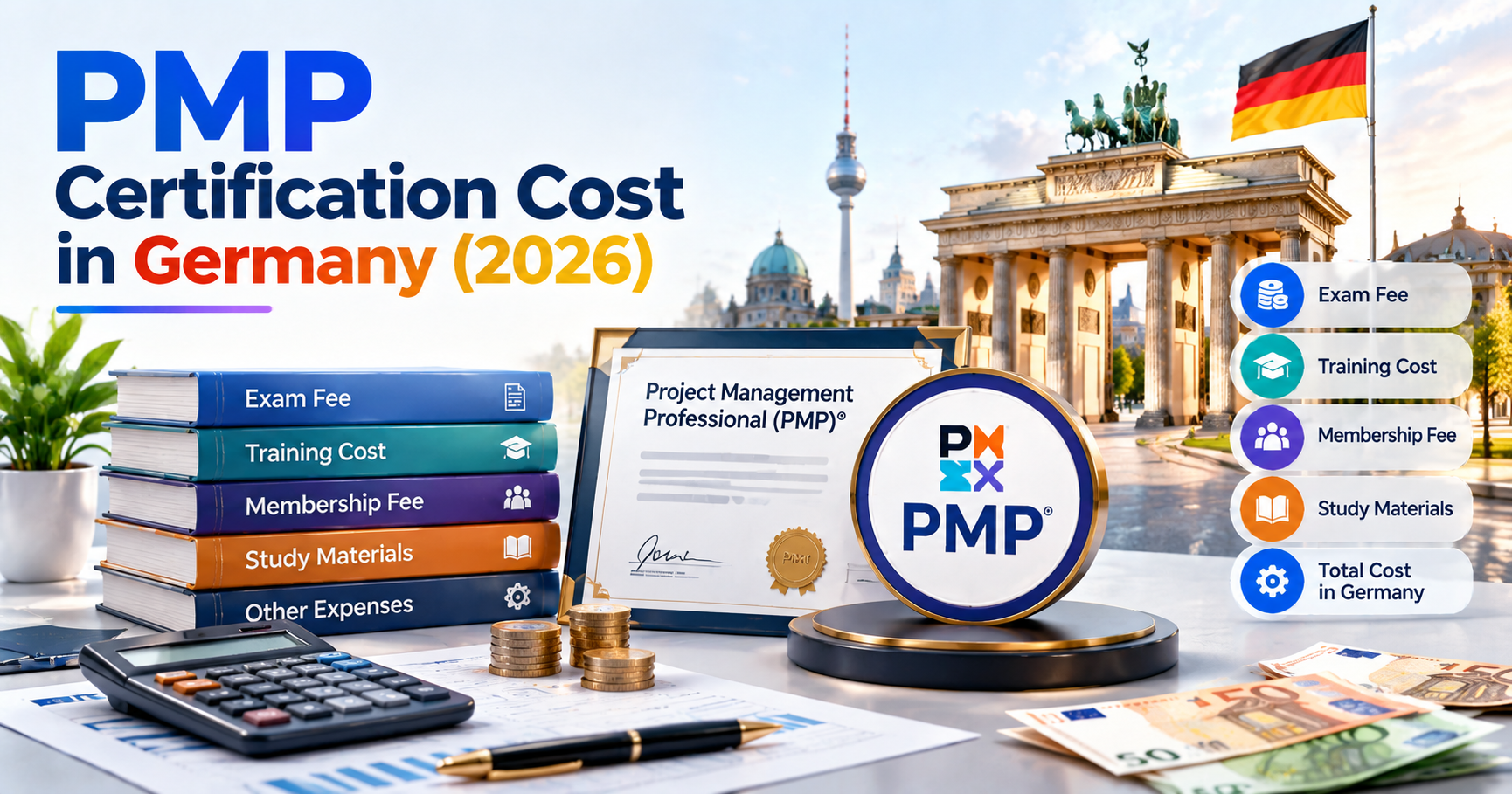
PMP certification in Germany typically costs between roughly EUR 750 and EUR 2,600 all-in, depending on training format and PMI membership status. The PMI exam fee alone is 445 USD for members and 675 USD for non-members, which converts to an estimated EUR 385 to EUR 590 at prevailing exchange rates in September 2026. Training adds anywhere from around EUR 400 for a self-paced course to over EUR 2,000 for a live instructor-led or classroom programme in a German city. The exact figure for any individual candidate depends on whether they join PMI first, which training format they choose, and whether their employer is funding some or all of the cost.
Key Highlights
- The PMI PMP exam fee is 445 USD for PMI members and 675 USD for non-members as of the August 2026 fee update, an estimated EUR 385 to EUR 590 depending on the day's exchange rate.
- PMI membership costs 154 USD a year plus a one-time 10 USD application fee (164 USD in year one, 149 USD on renewal), an estimated EUR 130 to EUR 145, and it pays for itself through the lower member exam fee alone.
- German training providers price PMP courses anywhere from around EUR 400 to EUR 500 for self-paced e-learning up to EUR 1,300 to EUR 2,300 for live online or classroom formats in cities such as Berlin, Munich, Frankfurt and Hamburg.
- Germany applies 19 per cent Mehrwertsteuer (VAT) to most commercial training services, so candidates should always check whether an advertised price is net (netto) or gross (brutto) before budgeting.
- Course fees, exam fees, study materials and even travel to training venues are generally deductible as Werbungskosten (job-related expenses) or Fortbildungskosten on a German tax return, which can meaningfully lower the effective cost.
- PMP renewal every three years costs 60 USD for members and 150 USD for non-members, roughly EUR 52 to EUR 130, on top of 60 PDUs that can largely be earned for free.
- From July 2026, PMI is running the PMP exam against a new Examination Content Outline, and by late 2026 it will only count training hours delivered by a PMI Authorized Training Partner, which raises the stakes on choosing an ATP-approved training provider.
How Much Does the PMI PMP Exam Fee Actually Cost in Germany?
The PMP exam fee is the one cost every candidate in Germany pays directly to PMI, and it is billed in US dollars regardless of where the candidate lives. PMI raised its fees on 6 August 2026, moving the member rate from 405 USD to 445 USD and the non-member rate from 555 USD to 675 USD. There is no separate EUR price list published by PMI for German candidates, so the euro figure a candidate actually pays depends on the exchange rate their card issuer applies on the day of payment, plus any foreign transaction fee their bank charges.
| Candidate status | PMI exam fee (USD) | Estimated EUR equivalent* |
| PMI member | 445 USD | Approx. EUR 385 to EUR 395 |
| Non-member | 675 USD | Approx. EUR 580 to EUR 600 |
| Retake fee, member | 275 USD | Approx. EUR 235 to EUR 245 |
| Retake fee, non-member | 385 USD | Approx. EUR 330 to EUR 340 |
*EUR figures are estimates only, based on an approximate USD to EUR conversion rate of around 0.86 to 0.87 in September 2026. They are not official PMI pricing and will move with the exchange rate on the day of payment; always confirm the exact USD charge and your bank's own conversion rate before budgeting.
PMI also introduced a new Examination Content Outline for the PMP exam from 9 July 2026 onward, alongside revised eligibility rules, a change thePMI Germany Chapterflagged to local members as one of the most significant updates to the credential in recent years. The fee increase and the content update landed in the same year, so candidates budgeting for 2026 should treat both the higher USD fee and the newer exam blueprint as the current baseline rather than referencing older German-language guides that still quote the pre-August pricing. You can confirm the live figure at any time on PMI's ownPMP certification page, since PMI does not commit to holding a euro price steady the way a training provider might.
Is PMI Membership Worth It for German Candidates?
For almost every German candidate, joining PMI before registering for the exam is the single easiest way to cut the total bill. Membership costs 154 USD a year with a one-time 10 USD application fee for new members, so the first year totals 164 USD, and renewal afterwards is 149 USD. Against that cost, membership immediately drops the exam fee from 675 USD to 445 USD, a saving of 230 USD, which more than covers the 164 USD membership outlay in the very same transaction.
| Item | Non-member route (USD) | Member route (USD) |
| PMI membership (year one) | 0 | 164 |
| PMP exam fee | 675 | 445 |
| Total before training | 675 | 609 |
| Net savings by joining PMI | – | 66 USD (approx. EUR 57) |
Beyond the arithmetic, membership also includes a free digital copy of the PMBOK Guide and related standards, discounted PMI chapter events (including the PMI Germany Chapter's own local meetups and webinars), and reduced pricing on some PMI-authored e-learning and renewal products. For a German candidate who plans to stay in project management for several years and will need to renew every three years anyway, the ongoing 149 USD annual renewal is usually offset by the lower renewal certification fee for members, discussed later in this guide. The only candidates who might reasonably skip membership are those sitting the exam once, with no intention of maintaining PMI ties afterwards, and even then the first-year savings alone tend to make joining the more rational financial choice.
What Do PMP Training Courses Cost in Germany?
Training is the most variable line item in a German PMP budget, and it typically costs more than the exam fee itself once live instruction is involved. PMI requires 35 contact hours of project management education to even apply for the exam, and by late 2026 PMI will only accept those hours if they come from a PMI Authorized Training Partner (ATP), which makes provider choice a compliance issue as well as a cost issue.
Self-paced online courses
Self-paced e-learning is the cheapest way to satisfy the 35-hour requirement, generally running from around EUR 400 to EUR 500 for a full course bundle with video lessons, practice questions and simulated exams. Simpliaxis's own PMP online training course sits in this format, letting candidates work through the material at their own pace without committing to fixed live session times, which suits candidates juggling a full-time job in Germany's demanding project environments.
Live online (virtual instructor-led) training
Live online training, where a trainer teaches a fixed cohort over several sessions by video, is the middle tier and the most common choice for working professionals in Germany. Market pricing for this format generally runs from roughly EUR 800 to EUR 1,400, though some providers price a full package, exam-tool access and coaching included, closer to EUR 750 plus VAT and upward. Simpliaxis runs PMP live online training across German cities including Berlin, Munich, Frankfurt, Hamburg, Dusseldorf and Darmstadt through its PMP Certification Training in Germanyprogramme, delivering the full PMI-approved 35 training hours as an Authorized Training Partner.
Classroom and in-person training
In-person classroom training remains available in major German cities but commands the highest price, generally EUR 1,300 to EUR 2,300 for a comprehensive multi-day programme, reflecting venue costs, printed materials and smaller class sizes. One provider's all-inclusive classroom package in Germany was quoted at around EUR 1,090 plus fees, while others price multi-day seminars above EUR 2,000 once travel-adjacent costs are folded in. Candidates comparing formats should weigh whether in-person delivery genuinely adds enough value over live online training to justify the premium, particularly given that the exam itself is identical regardless of how the 35 hours were delivered.
Corporate and group training
For companies rather than individuals, per-seat pricing drops meaningfully once several project managers are certified together, and this is where organisational budgeting changes the calculation entirely. PMO and L&D managers who need to certify a whole project team, rather than a single employee, typically get far better per-head economics and a single consolidated invoice through a dedicated corporate arrangement such as Simpliaxis'scorporate and group training programme, which customises PMP cohorts for organisations and negotiates group rates that individual registrations cannot match. Given that non-ATP training hours will stop counting toward PMP eligibility by late 2026, German employers sourcing group PMP training should confirm ATP status as part of that procurement decision, not just price.
Total Cost of Ownership: Budgeting the Full PMP Journey in Germany
Adding the exam fee, membership, and training together gives a realistic all-in figure rather than looking at any single line item in isolation. The table below sketches three common budgeting scenarios for a German candidate in 2026.
| Scenario | Training format | Training cost (EUR, est.) | PMI membership + exam (EUR, est.) | Total (EUR, est.) |
| Lean budget | Self-paced e-learning | 400 to 500 | approx. 440 (member route) | approx. 840 to 940 |
| Mid-range budget | Live online, instructor-led | 900 to 1,400 | approx. 440 (member route) | approx. 1,340 to 1,840 |
| Premium budget | Classroom / in-person | 1,300 to 2,300 | approx. 440 (member route) | approx. 1,740 to 2,740 |
These figures assume the candidate joins PMI first and pays the member exam rate, and they exclude VAT that may be added to the training portion, plus any retake fee if a first attempt is unsuccessful. For a fuller, country-neutral view of how each cost component is calculated, Simpliaxis's ownPMP Certification Cost breakdownwalks through the same fee categories in more depth and is a useful cross-check when comparing quotes from different training providers. German candidates should treat the ranges above as planning bands rather than fixed quotes, since actual training prices move with provider, city and current promotions.
Currency, VAT and Tax Deductibility: What German Candidates Need to Know
Why the EUR price is always an estimate
PMI bills the exam fee and membership exclusively in US dollars, so there is no fixed euro price a German candidate can lock in ahead of time. The actual amount debited depends on the EUR/USD rate applied at the moment of payment and on whether the candidate's card issuer adds a foreign transaction fee, commonly 1 to 3 per cent on top. As of mid-September 2026, 1 USD converts to roughly EUR 0.86 to 0.87, but this rate moves daily, so any EUR figure quoted for the PMI fee, including the ones in this guide, should be treated as an estimate rather than an invoice amount.
German VAT on training fees
Germany applies 19 per cent Mehrwertsteuer to most commercial training services sold to consumers, though the way it appears on an invoice depends on the seller. A training company established in Germany or elsewhere in the EU typically quotes a net price and adds 19 per cent VAT for private individuals, while training purchased business-to-business from outside the EU may instead fall under the reverse-charge mechanism, where the German buyer self-assesses VAT rather than being charged it directly by the seller. In practice, this means a course advertised at, say, EUR 900 net could land at roughly EUR 1,071 gross once VAT is added for a private buyer, so it is worth asking any provider explicitly whether their quoted price is netto or brutto before comparing options. The PMI exam fee itself, paid directly to a US-based non-profit, is not typically subject to German VAT in the same way a locally delivered training service is.
Deducting PMP costs as Werbungskosten or Fortbildungskosten
Employed professionals in Germany can generally deduct the full cost of a job-related further qualification, Fortbildungskosten, as Werbungskosten on their annual tax return, provided the certification has a clear connection to their current or a realistically intended future role. This typically covers the exam fee, training course fees, the PMBOK Guide and other study materials, and, where the training happens away from home, reasonable travel and accommodation costs, provided receipts are kept. Self-employed project managers can generally claim the same costs as Betriebsausgaben (business expenses) against their income instead. Because Germany's income tax rates are progressive, the effective after-tax cost of certification can end up meaningfully lower than the sticker price, though the exact saving depends on each candidate's marginal tax rate and is worth confirming with a Steuerberater or a standard tax-filing tool rather than assuming a fixed percentage.
Bildungsurlaub: paid educational leave
Fourteen of Germany's sixteen federal states offer a statutory entitlement to Bildungsurlaub, additional paid leave specifically for approved further education, which can be used to attend PMP training without burning ordinary holiday allowance. Where an employer's HR department confirms a chosen course qualifies, this does not reduce the cash cost of certification, but it does reduce the effective cost in lost annual leave, which is a real budgeting factor for candidates weighing classroom training that runs across several consecutive working days.
How to Reduce Your PMP Certification Cost in Germany?
Several practical choices, made before registering, can bring the total bill down without cutting corners on exam readiness.
- Join PMI before you register: paying the 164 USD first-year membership fee before booking the exam saves 230 USD on the exam fee alone, a net saving even before counting the free PMBOK Guide and member resources.
- Match the training format to your schedule, not the marketing: self-paced e-learning satisfies the same 35-hour PMI requirement as a classroom course at a fraction of the price, so candidates who are disciplined self-studiers can save well over a thousand euros by choosing that format. Simpliaxis's comparison of PMP training providersis a useful reference point when weighing format and price against what different providers actually include.
- Ask your employer to fund or part-fund the certification: many German employers treat PMP as a strategic capability and will cover training costs, especially when a PMO or L&D manager frames the request around organisational project delivery outcomes rather than an individual's career development alone.
- Pool certifications across a team: where three or more colleagues need PMP at the same time, arranging training through a corporate or group programme rather than individual bookings typically secures a lower per-seat rate and a single consolidated invoice for finance to process.
- Claim the cost back through your tax return: keeping every receipt, exam fee, course invoice, study materials and eligible travel, and declaring them as Werbungskosten reduces the effective net cost once the tax refund lands.
- Use Bildungsurlaub where available: requesting statutory educational leave for classroom or intensive live online training avoids using annual leave days, which is not a cash saving but does protect personal holiday time.
- Pass on the first attempt: a retake costs 275 USD for members and 385 USD for non-members on top of everything already spent, so investing adequately in a proper prep course the first time around is usually cheaper than trying to save on training and risking a second exam fee.
PMP Renewal and PDU Costs: The Ongoing Cost of Ownership
PMP certification is not a one-time purchase, and German candidates should budget for renewal every three years to keep the credential active. PMI's Continuing Certification Requirements (CCR) cycle runs for three years from the date a candidate passes the exam, during which they must earn 60 Professional Development Units (PDUs), including at least 35 from the Education category, before paying a renewal fee.
| Renewal item | Cost (USD) | Estimated EUR equivalent* |
| Renewal fee, PMI member | 60 USD | Approx. EUR 50 to EUR 55 |
| Renewal fee, non-member | 150 USD | Approx. EUR 125 to EUR 135 |
| PDUs required per cycle | 60 PDUs | Can largely be earned free of charge |
PDUs themselves can often be earned at no cost through free PMI webinars, volunteering, reading and PMI Germany Chapter events, though some candidates choose to buy a bundled PDU course for convenience, which can add anywhere from nothing to a few hundred euros depending on the provider. Because the renewal fee gap between members and non-members (90 USD, roughly EUR 78) tends to exceed the annual membership renewal cost, staying a PMI member after passing the exam is usually the cheaper long-term path, and Simpliaxis's own PMP Certification Renewal Fee guide sets out the renewal timeline and PDU categories in more detail for anyone planning their three-year cycle in advance.
Does Taking the Exam in German Change the Cost?
No, choosing to sit the PMP exam in German rather than English does not change the fee PMI charges. PMI offers the PMP exam in a range of languages including German, alongside English, Spanish, French, Italian, Japanese, Korean, Chinese and several others, and a candidate testing in German can toggle back to the original English wording of any question if a translation feels ambiguous. The choice of exam language mainly affects comfort and confidence during the exam itself rather than the fee structure, which stays identical for member and non-member candidates regardless of which language they select at registration. Where language does affect cost indirectly is training material selection: candidates who prefer to prepare in German sometimes have a narrower pool of German-language self-paced courses to choose from than the English-language market, which can nudge some toward live, instructor-led formats instead.
Conclusion
The headline PMI exam fee is the same wherever a candidate sits the test, but the real cost of becomingPMP certified in Germanyis shaped by three decisions that are entirely within a candidate's control: whether to join PMI before registering, which training format actually matches their study style and schedule, and whether they, or their employer, can capture the tax and VAT mechanics available to German taxpayers. A candidate who joins PMI, chooses a self-paced or live online course from an Authorized Training Partner, and later claims the cost as Werbungskosten can realistically bring their all-in spend closer to the lower end of the roughly EUR 840 to EUR 2,700 range mapped out in this guide, while someone who defaults to non-member pricing and premium classroom training without checking VAT treatment will land at the top of it for the same credential. With PMI's fee increase and new exam content outline both landing in 2026, and with training-hour eligibility rules tightening toward Authorized Training Partners by year-end, the practical takeaway for German candidates and the PMO or L&D managers funding them is to lock in provider and membership decisions early, on current 2026 pricing, rather than budgeting against older figures that no longer reflect what PMI or the market actually charges.






 Lowest-Price Challenge











 Personalized Path


.webp)


 USA
USA  Canada
 India
India UK
UK Australia
 Singapore


