


 Call Us




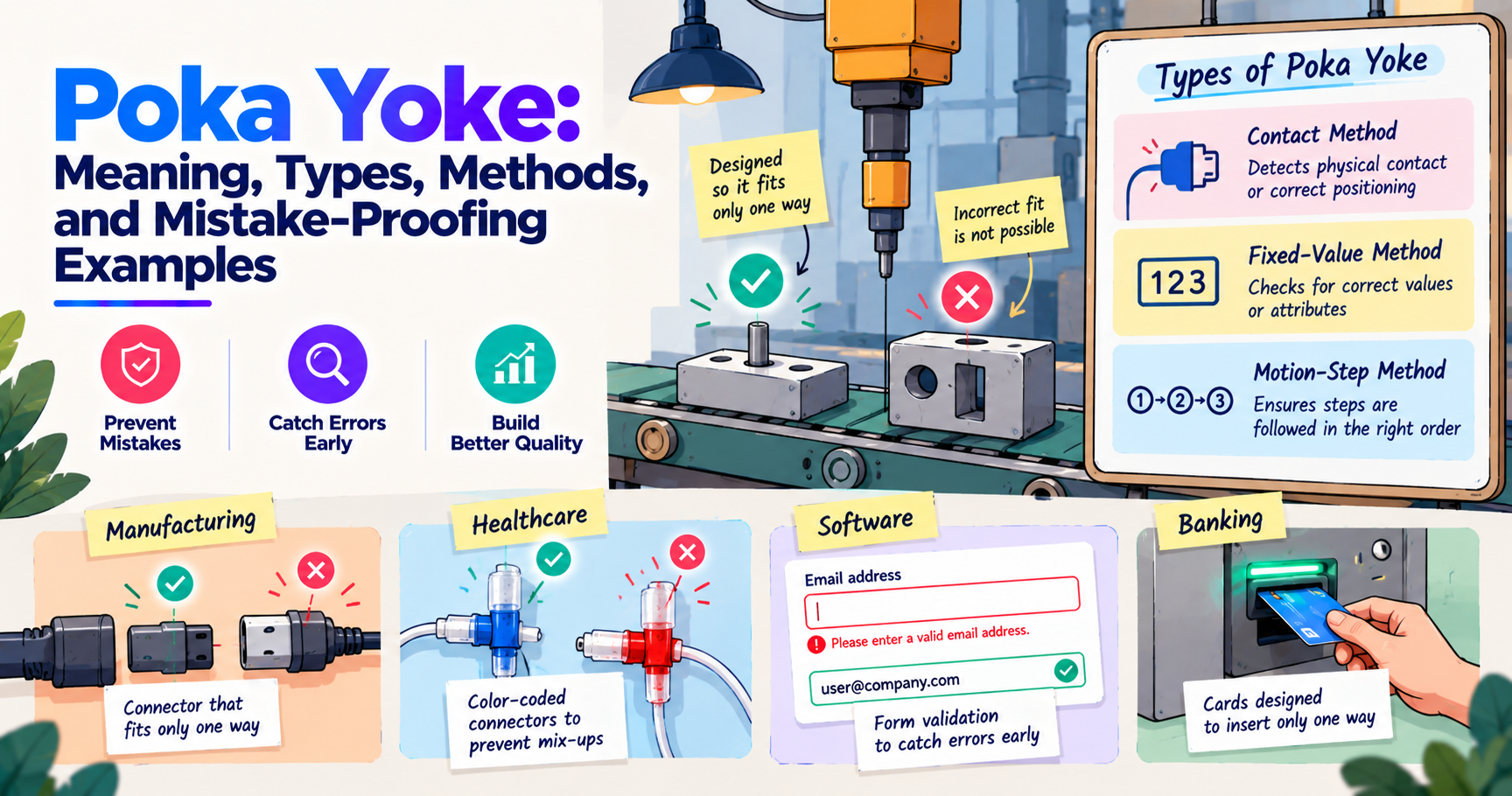
Poka yoke is a lean technique that helps prevent mistakes or catches them before they cause defects. The Japanese term means mistake-proofing. Rather than expecting people to remember every instruction and get every step right, poka yoke makes the process itself more reliable. A connector that fits only one way, a machine that won't run with its safety cover open, and an online form that flags missing information are everyday examples. In the workplace, these safeguards help reduce rework, prevent avoidable errors, and maintain consistent quality.
Key Highlights of Poka Yoke
- Poka Yoke means designing a process to prevent mistakes or catch them before they cause defects.
- There are three main types of Poka Yoke: contact method, fixed-value method, and motion-step method.
- There are two approaches to it: warning systems alert people to errors, while control systems prevent incorrect actions from continuing.
- The use of Poka Yoke can be seen in manufacturing, healthcare, software, banking, and everyday products.
- Poka yoke is relevant to Lean Six Sigma practitioners since it helps in mistake proofing, supports defect prevention, and builds quality and the goal of zero defects.
- Teams can introduce poka yoke during the Improve and Maintain the solution through the Control phase of the DMAIC framework.
Introduction
Think about the last time you made a small mistake that created a surprisingly large amount of extra work. Maybe you entered the wrong number in a spreadsheet, missed a step while filling out a form, or assembled something incorrectly and had to take it apart again.
That could be annoying. But it's worse when the same mistake is made again and again even when everybody is warned to be careful.
These small errors can pile up at work. One missing part on a production line can hold up an entire batch. A wrong entry might result in a delay in the processing of a customer’s request. If an inspection is missed, a flaw can reach someone who expects a good product.
Just telling people to pay more attention doesn’t always work. When work is busy, people get tired, tasks can become repetitive, and instructions can be easy to miss.
This is where poka yoke comes into play.
Instead of depending completely on people to remember every detail, Poka-yoke builds safeguards into the process. A component might be redesigned so it cannot be fitted incorrectly, or a machine might refuse to start until a required step is complete.
The goal isn't to make work more complicated with extra checks. It's to take away opportunities for error where we can.
For anyone learning Lean Six Sigma principles, poka yoke is an important concept because it changes how we think about quality. Rather than waiting for something to go wrong and then fixing it, we look for ways to prevent the problem in the first place.
What Is Poka Yoke?
Poka yoke is a mistake-proofing technique that prevents human errors or detects them just before they result in defects, delays, or safety problems.
Simply put, “poka yoke” means designing a process so that it is difficult to do something incorrectly and easy to recognize a mistake.
Imagine a factory that assembles electronic products. There is one piece that can be fitted in two orientations, but only one of these is correct. If a worker installs it backward, the problem may not be evident until the product is inspected or tested.
The factory could include an extra inspection step. That might catch some errors, but it also adds work and leaves room for defects to slip through.
A poka yoke solution tackles the problem earlier. The component or its fixture is redesigned so it fits only in the correct position.
The difference is significant. Instead of asking someone to spot the mistake later, the process helps prevent it from happening at all.
Poka yoke is one of the practical Six Sigma Green Belt tools used to improve process reliability. It also supports what is the lean process by reducing avoidable waste, unnecessary corrections, and delays.
Of course, not every error can be eliminated through design. Some need to be detected rather than prevented. The important thing is to catch them as close to their source as possible.
Origin and Shigeo Shingo
When discussing poka yoke, one name comes up repeatedly: Shigeo Shingo, a Japanese industrial engineer whose work helped shape modern manufacturing practices and the Toyota Production System.
Shingo understood that even well-trained employees make mistakes. Someone might understand a procedure perfectly and still forget a step when performing the same task hundreds of times.
The obvious response is to offer more training or remind employees to be careful. Sometimes that helps. But if the process makes the error easy to commit, reminders alone may not be enough.
Shingo encouraged organizations to look beyond the person who made the mistake and examine the conditions that allowed it to happen.
The terminology has an interesting history, too. The concept was initially called baka-yoke, which translates to fool-proofing. The term was later changed to poka yoke," or "mistake-proofing," because the original wording could sound insulting to workers.
That change fits the underlying philosophy. When an error occurs, the first question shouldn't automatically be, "Who got this wrong?" It should also be, "What could we change so this is less likely to happen again?"
Today, the same thinking is used far beyond manufacturing. Hospitals use identity checks, software applications validate information, and service teams build safeguards into their workflows.
For more background, see the Lean Enterprise Institute: poka yoke.
Poka Yoke and Zero Quality Control
Shigeo Shingo also developed the concept of Zero Quality Control (ZQC), which focuses on preventing defects rather than relying mainly on inspections to find them after production.
The idea isn't that every defect will magically disappear. It is that companies should focus on preventing problems rather than just accepting defects as something to be fixed after the fact.
Three practices are of particular relevance:
- Source inspection: Checking for possible errors at the actual location where the work is being done.
- Self-inspection: enabling employees to inspect their own work at once after completing a task.
- Sucessive inspection: the next person in the process inspects the prior step before moving on.
Poka yoke makes it easier to detect or even to prevent errors, thus facilitating these practices.
It also ties in with jidoka, a principle of the Toyota Production System that allows a process or machine to detect abnormalities and stop when needed. This prevents a problem from continuing unnoticed through multiple stages of production.
You can explore the concept through the Lean Enterprise Institute: jidoka.
Together, these practices support built-in quality, a core idea in total quality management. Instead of leaving quality entirely to a separate inspection team, they make it part of how work gets done.
Poka Yoke Types
Mistakes don't all happen in the same way. Sometimes a component is fitted incorrectly. Sometimes a worker forgets an item. In other cases, the right steps are completed in the wrong order.
Poka yoke offers different methods for dealing with these situations. Understanding the type of error helps you choose a solution that addresses the actual problem.
The three commonly recognized methods are contact, fixed-value, and motion-step. Solutions can also be classified as warning or control systems.
Contact Method
The contact method helps find mistakes by checking a physical characteristic such as shape, size, position, or orientation.
A familiar example is a component that fits into an assembly in only one direction. If someone tries to fit it incorrectly, the design prevents the error.
Other examples include:
- A connector that fits only into a compatible socket.
- A fixture that holds a component in the correct position.
- A sensor that detects when an item hasn't been placed correctly.
This method is particularly useful in poka yoke manufacturing, where an incorrectly positioned component can affect the finished product.
Fixed-Value Method
The fixed-value method ensures that the right number of actions, components or items are applied.
This is helpful when a task has a lot of little steps that are easy to miss.
Suppose a technician needs to put eight screws into a product. The work is repetitive, and you can lose count along the way. You can have a counter to know how many screws are installed and mark the assembly if the total number required is not reached.
Other examples are
- A kit containing only the quantity of parts necessary for an assembly.
- A counter to count the number of fasteners installed.
- A digital checklist that shows steps that are not completed.
The aim is to make omissions easier to spot without expecting someone to remember every detail.
Motion-Step Method
The motion-step method ensures that a task follows the correct sequence.
This is important when performing steps out of order could lead to a defect or a safety risk.
For example, a machine may not run unless its protective cover is fastened. There is an interlock so the machine will not start unless the cover is on.
Other examples are
- Equipment that cannot start its next cycle until the current cycle is completed.
- A digital workflow that requires identity verification before payment processing.
- An assembly process that verifies the required sequence of component installation.
The right sequence can be put into the process, which improves the odds of businesses not missing important steps.
Warning vs. Control Poka Yoke
Poka yoke solutions can also be classified by how they respond when something goes wrong.
| Approach | How it works | Example |
| Warning | Alerts the user to a mistake or abnormal condition. | An alarm sounds when a machine detects a missing component. |
| Control | Prevents an incorrect action or stops the process from continuing. | The machine won't start if the part is not installed properly |
Warnings are useful when the user can safely fix the problem after being notified. But an alarm doesn’t guaranty the person will hear it or react to it.
Control systems are more secure because they will not allow the process to continue if it is not under the right conditions.
The right choice is situational. A reminder may be enough for a routine administrative task, while a safety-critical operation may require an automatic interlock.
Poka Yoke Examples
Poka yoke can be found in places people don't always associate with quality management. Some are embedded in everyday products, and some involve sensors or software or simple changes to how work is organized.
The common thread is that they address a predictable mistake before it creates a bigger problem.
Poka Yoke Manufacturing Examples
Manufacturing is one of the most common applications of mistake-proofing. A minor assembly mistake can result in scrapped products, expensive rework, late orders, or customer complaints.
Here are three real-world examples:
1. Assembly fixtures
A worker needs to fit a component that can easily be installed backward. The manufacturer introduces a fixture that accepts the part only in the correct orientation.
The worker doesn't have to keep checking its position, and the risk of incorrect assembly is reduced.
2. Missing-component sensors
An electronic product needs five components before its casing can be closed. A sensor checks whether all five are present.
If one is missing, the system pauses the process and alerts the operator. The product can be corrected before it moves to the next stage.
3. Color-coded connections
Factories often use color-coded labels to help employees distinguish between similar cables, pipes, and connectors.
These visual cues make identification easier. However, colour coding alone doesn't prevent an incorrect connection. Where the consequences could be serious, a keyed connector that physically prevents incompatible connections offers stronger protection.
Everyday Examples
You probably encounter poka-yoke more often than you realize. Everyday products have built in safeguards that help prevent common mistakes without the users having to think about it.
- Microwave ovens: Many stop heating when the door is opened, which helps prevent unsafe operation.
- Washing machines: Most have door or lid interlocks that prevent some cycles being run with the door open.
- Cars: Seat-belt reminders warn drivers or passengers when a seat-belt is unbuckled. It is a warning system, not a prevention system.
- ATMs: Some machines remind users to take their cards before ending a session, so the card is less likely to be left behind.
- Fuel connections: In some markets, nozzle and filler designs help prevent incompatible fuel connections, although the protection varies by vehicle and fuel system.
What makes these examples useful is how little extra effort they demand from the user. You don't need to memorize another instruction every time you use the product. The design does some of the work for you.
Software and Service Examples
A mistake doesn't have to involve a physical component. In digital and service-based processes, an incomplete form, duplicate payment, or incorrectly booked appointment can create just as much trouble.
Poka yoke prevents these errors from reaching the customer.
1. Mandatory form fields
The online application flags fields that are required and will not let you submit until you have entered the essential information. This minimizes incomplete applications and the need for repeated follow-ups.
2. Password validation
When you register, the registration page validates that the password you entered meets the criteria. A confirmation field may also detect unintentional typing differences.
3. Avoiding duplicate payments
Payment systems sometimes disable a submit button while a transaction is being processed. Unique transaction identifiers can also be used to avoid duplicate requests.
These measures prevent the possibility that someone will mistakenly pay twice for one item.
How to Implement Poka Yoke Step by Step
You don't need to redesign an entire operation to start using Poka-yoke. A good place to start is with a recurring mistake that wastes time, affects quality, or creates unnecessary risk.
What matters is to understand why the error occurs before deciding how to avoid it.
Identify Error-Prone Steps
Look at where mistakes are most frequent or where the consequences are most serious. That's the first step.
Defect records, customer complaints, rework logs, audit findings, and feedback from the people who do the task every day are useful sources.
Let's take the example of the missing washer during assembly.
Before adding another inspection step, ask why the washer keeps getting missed. Is it difficult to see? Is it stored separately from the other components? Does the worker have to remember an extra step while handling several tasks at once?
These questions can help to find the real root cause and not just treat every missed washer as an isolated error made by an employee.
Teams can also use Failure Mode and Effects Analysis (FMEA) to identify potential failures, understand the consequences, and decide which risks to address first.
When the cause isn't obvious, root cause analysis can help explain why the problem keeps returning.
Choose the Device or Method
Once the team understands the problem, it's time to choose a solution that addresses it directly.
Depending on the situation, the solution might involve:
- Physical design changes: Use fixtures or guides that prevent incorrect assembly.
- Sensors and interlocks: Detect missing parts or stop equipment from operating under unsafe conditions.
- Counters: Check whether the required number of components or actions has been completed.
- Visual controls: Use labels, color coding, and clear markings to reduce confusion.
- Digital validation: Prevent incomplete submissions, incorrect data formats, or duplicate requests.
- Sequence controls: Ensure the required steps are completed in the correct order.
Keep the solution practical. If a simple fixture can prevent the mistake reliably, an expensive automated system may not be necessary.
It's also worth checking whether the proposed solution could slow down the process, generate false alarms, or introduce another problem.
Test and Standardize
Before rolling out the solution across the entire operation, test it on a smaller scale.
Suppose the team has introduced a fixture to prevent missing washers. Check whether it works consistently, whether employees can use it comfortably, and whether it creates any unexpected difficulties.
Once the solution proves effective, make it part of the standard process.
- Document the updated procedure.
- Revise the standard work instructions.
- Train employees on the new method where needed.
- Track results such as defect rates, rework, and false alarms.
- Review the safeguard regularly and improve it when necessary.
This is how process improvement becomes part of everyday work rather than a one-time project.
The idea behind kaizen poka yoke fits naturally here: learn from recurring problems, make practical changes, and keep finding ways to improve the process.
Benefits and Limitations of Mistake Proofing
Mistake proofing can make work more reliable, but it isn't a solution to every quality problem. Its effectiveness depends on whether the safeguard addresses the actual cause of the error and whether it continues to work as intended.
Benefits
Fewer defects and less rework: Catching an error early means fewer faulty products or incorrect transactions need to be corrected later.
Better productivity: Employees spend less time repeating tasks, investigating mistakes, and waiting for inspections.
More consistent quality: Standardized safeguards help reduce variation between workers, shifts, and production runs.
Improved safety: Properly designed interlocks and verification systems can prevent certain hazardous actions.
Stronger quality assurance: Quality becomes part of the process instead of depending entirely on someone inspecting the finished output.
Lower operating costs: Less scrap, rework, and fewer customer returns can reduce the overall cost of quality.
Poka yoke also supports the goal of zero defects. Although eliminating every possible defect may not be realistic, reducing preventable errors is a practical step towards more reliable operations.
Limitations
Some errors are difficult to prevent: Complex processes can involve unexpected situations that a single safeguard cannot address.
Initial investment may be required: Sensors, fixtures, equipment changes, and software modifications can involve upfront costs.
False alarms can interrupt work: A poorly calibrated sensor may flag an acceptable product and slow down production.
People may become overdependent on the system: Employees might assume every mistake will be caught automatically, even when the safeguard has limitations.
Safeguards need maintenance: Sensors can fail, equipment can wear out, and software rules can become outdated.
The wrong solution can miss the real problem: Adding another inspection step may not help if the underlying cause of the error remains unchanged.
These limitations are worth considering before implementing a solution. A good poka yoke system should be tested, monitored, and reviewed rather than treated as a guarantee that nothing can go wrong.
Poka Yoke in the DMAIC Control Phase
DMAIC is an acronym for Define, Measure, Analyze, Improve and Control. It’s a structured Six Sigma methodology to help teams investigate problems, test solutions and sustain improvements.
Often in the Improve phase a team will design a way to prevent or minimize an error using poka yoke.Then the control phase makes sure that the solution keeps on working after the end of the improvement project.
Consider a packaging line where customers periodically receive boxes with missing components.
First, the team defines the problem and measures its frequency. It then looks at why components are being missed and introduces a sensor that checks the count before each box is sealed.
But the job is not done when the sensor is installed.
The team still needs to make sure it works reliably, employees know what to do when an error is flagged, and the problem doesn't start cropping up again a few weeks down the line.
During Control, the team monitors defect rates, assigns responsibility for maintenance, and establishes what to do when the system detects an error.
For professionals preparing for the Lean Six Sigma Green Belt certification, one distinction is worth remembering: poka yoke isn't exclusive to control. It can be introduced earlier and then maintained through the control phase.
Linking Poka Yoke to the Control Plan
A control plan explains how a process will be monitored after an improvement has been introduced. It identifies what needs to be checked, how often checks should happen, who is responsible, and what action to take when something goes wrong.
A poka yoke device can become part of that plan.
For example, a final assembly process may require every product to contain a specific number of fasteners.
| Control Plan Element | Example |
| Process step | Final assembly |
| Potential error | Missing fastener |
| Control method | Sensor-based fastener verification |
| Monitoring | Automatic check for every assembly |
| Responsibility | Production supervisor |
| Reaction plan | Stop the cycle, correct the assembly, and record the issue |
A well-prepared control plan in Six Sigma helps ensure that mistake proofing remains part of everyday operations.
The team should also check the device periodically. A failed sensor or bypassed interlock can leave the process vulnerable to the same problem the safeguard was designed to prevent.
Poka Yoke in the Green Belt Exam
If you're preparing for a Lean Six Sigma Green Belt exam, it's worth understanding poka yoke beyond its definition. Questions may ask you to identify a mistake-proofing method, distinguish prevention from detection, or explain how a solution fits into DMAIC.
Here are the points to keep in mind:
- Purpose: Prevent mistakes or detect them immediately before they become defects.
- Contact method: Uses physical characteristics such as shape, size, or position.
- Fixed-value method: Checks that the correct number of items or actions is present.
- Motion-step method: Ensures that tasks follow the correct sequence.
- Warning versus control: Warnings alert users, while controls prevent incorrect actions or stop the process.
- DMAIC connection: Poka yoke can be implemented during improvement and sustained through control.
One distinction is particularly important. Inspection identifies problems with the output, while mistake proofing aims to prevent the error or stop it from progressing through the process.
For additional preparation, try a Lean Six Sigma Green Belt practice test. Working through practical scenarios can help you recognize which method fits a particular problem instead of simply memorizing definitions.
You might also come across the misspelling "poke yoke" in informal searches. The standard spelling is poka yoke.
Conclusion
Poka yoke is built around a simple idea: people make mistakes, but the way a process is designed can determine how often those mistakes happen and how much damage they cause.
A fixture that accepts a component in only one direction, a sensor that detects a missing part, or an online form that flags incomplete information can prevent problems before they move further through a process.
Mistake proofing is only valuable when it is done at the point of the mistake. Instead of repeatedly fixing the same defect, teams can investigate the root cause, institute a practical safeguard, and incorporate the improved method into standard work.
Poka yoke does not replace skilled workers, sound procedures, or quality checks. It gives people a process that supports them and makes reliable work easier to achieve.
Whether you're working in manufacturing, software, healthcare, or service delivery, start by asking one question: What could we change about this process to make the same mistake less likely next time?
That question is usually the first step towards better quality.






 Lowest-Price Challenge












 Personalized Path



.webp)


 USA
 Canada
 India
 UK
 Australia
 Singapore


