


 Call Us




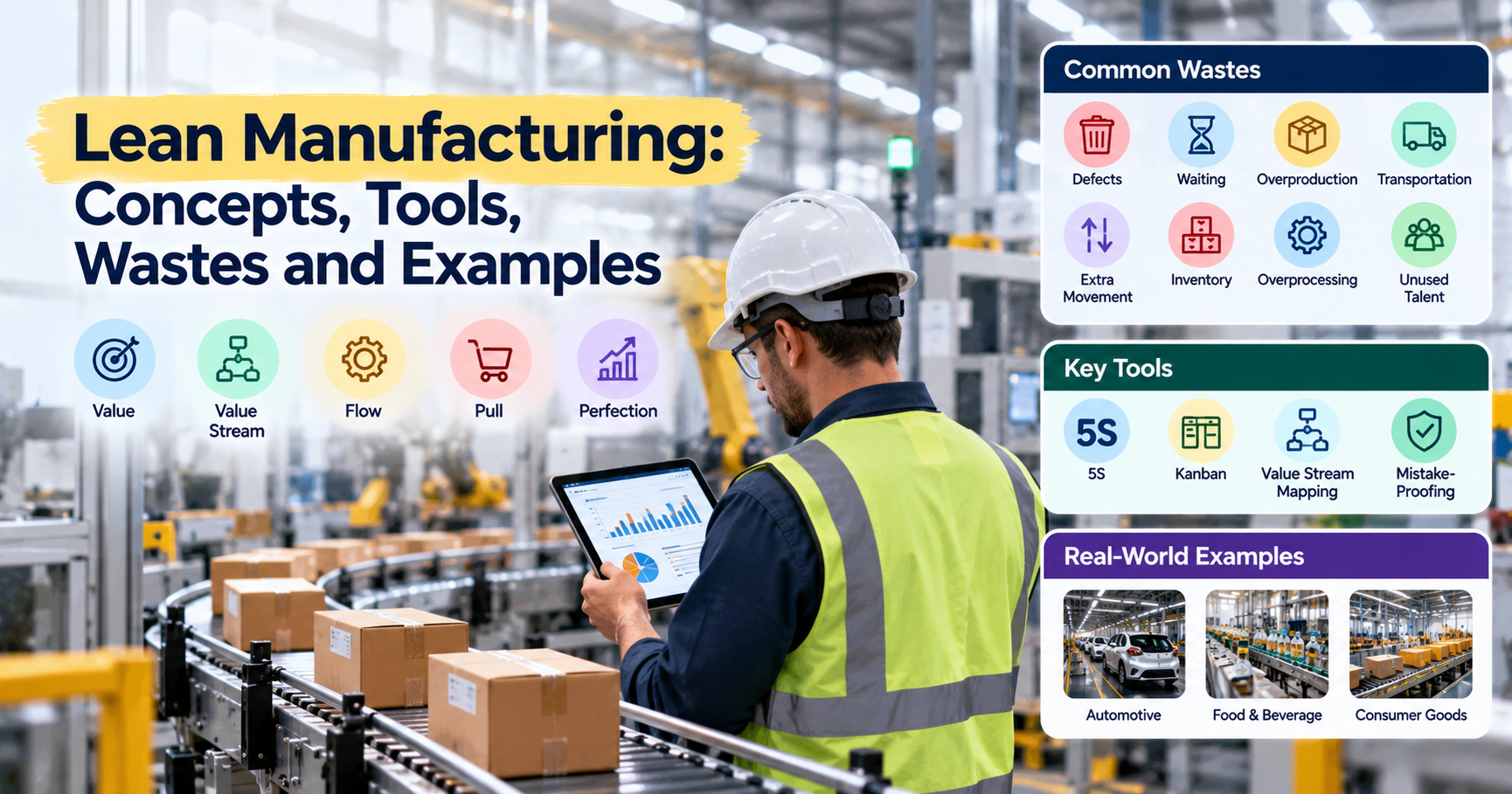
Lean Manufacturing: Concepts, Tools, Wastes and Examples
Lean manufacturing is a way to make things with less waste. The basic idea is simple. A business should invest its time, money and effort in things that matter to the customer. It should also look for ways to eliminate extra work, avoid delays and make better use of its people and materials.
Five basic principles govern lean manufacturing. The principles are defining value, mapping the value stream, creating flow, using a pull system, and striving for perfection. Companies implement these ideas with tools like 5S, Kanban, value stream mapping, and mistake-proofing.
Key Highlights of Lean Manufacturing
- Lean manufacturing helps reduce waste and makes work easier to manage.
- It follows five main principles, from understanding customer needs to making regular improvements.
- The eight wastes include defects, waiting, extra movement, and making more than needed.
- Tools such as 5S, Kanban, and value stream mapping help teams find and fix problems.
- Lean works best when people at every level take part in improving the way work gets done.
Introduction
Think about a factory where workers spend half their shift looking for tools. Materials are late, machines are idle and finished goods sit for hours before moving to the next stage. Everyone is working on it, but it is still too long.
Now imagine the same factory with tools in the right place, materials ready when needed, and less delay between jobs. Workers can concentrate on their work and not spend the whole day solving small problems.
This is the kind of change lean manufacturing aims to bring.
The idea is not to make people work faster every minute. It is to remove the things that make their work harder than it needs to be. These may be extra steps, poor planning, repeated work, or delays that no one has stopped to question.
Lean manufacturing is an easy way for companies to review what they do every day and ask, “Do we need to do this at all?” It could be worth taking a closer look at tasks that don’t help the customer or contribute to the process.
It’s used in manufacturing, but the ideas behind it can be applied in offices, hospitals, warehouses and other workplaces. Wherever there is delay in work or wastage of resources, there may be scope for improvement.
What Is Lean Manufacturing?
Lean manufacturing is a method of making things that uses less time, effort, space and material. The emphasis is on providing customers with what they need without introducing steps or costs that do not add value.
For example, a factory might discover that workers walk across the floor several times a day simply to get tools. The rides are only a few minutes each, so the problem might not seem too bad at first. But when several workers do this every day, the lost time adds up.
Moving the tools closer to the work area may solve the problem. The workers do not need to rush. They can simply spend less time walking and more time doing the work they were hired to do.
This is one small example of lean manufacturing in action.
The approach also looks at problems such as damaged products, too much stock, long waiting times, and work that needs to be done again. Rather than treating each issue as a one-time problem, teams try to find out why it keeps happening.
The goal is to make the whole process work better, not just one part of it.
The Lean Enterprise Institute's explanation of lean covers the idea of creating value while removing waste. You can also read this Wikipedia overview of lean manufacturing for a broader look at the method and its history.
History From Toyota to Global Industry
Lean manufacturing is closely linked to the Toyota Production System. Toyota developed ways to make production more reliable while keeping waste under control. The company needed to use its resources carefully and make products that met customer needs.
Two ideas became especially important. The first was making only what was needed, when it was needed. The second was building quality into the work instead of waiting until the end to find problems.
These ideas went into creating the lean methods we use today. Little by little, other companies started to use similar methods to improve their work.
You can read more about these ideas in Toyota's explanation of the Toyota Production System.
Lean manufacturing today is not simply about machines and factory floors. A team might apply lean thinking to reduce the time to process an order, manage stock or fix a problem that keeps coming back.
The work may vary from industry to industry, but the basic objective is the same. Figure out what’s blocking things. Cut out waste where you can and make the process easier to run.
Lean Manufacturing vs Six Sigma
Lean manufacturing and Six Sigma both aim to improve the way work gets done, but they focus on different things.
Lean looks hard at waste. It asks whether there is a real need for a task, a movement or a delay. It also tries to find ways to help work move from one step to the next without getting stuck.
Six Sigma is more focused on eliminating errors and keeping results consistent. It uses data to find out why problems occur and what can be done to stop them.
For example, a factory may have a long wait between two stages of production. Lean methods can help the team find out why the wait happens and reduce it. If the factory also finds that products often have the same defect, Six Sigma methods can help the team study the cause and reduce the number of faulty products.
Many businesses use both approaches. This is often called Lean Six Sigma.
If you want to understand how they work together, read about Lean Six Sigma principles and the differences in Lean Six Sigma vs Six Sigma.
The 5 Lean Manufacturing Principles
The five lean manufacturing principles give businesses a clear starting point. They help teams understand what customers need, look at the work involved, and find ways to improve it.
These principles are connected. A team cannot remove waste properly without knowing what matters to the customer. It also needs to look at the full process instead of fixing one small part and ignoring the rest.
1. Define Value
The first step is to understand what the customer actually wants.
This sounds simple, but businesses can spend a lot of time and money on things customers do not really care about. They may add extra features, use more packaging than needed, or spend time on checks that do not improve the product.
Defining value means looking at the product or service from the customer's point of view.
A customer who is buying a chair might worry about comfort, strength, price and delivery time. Fancy packaging may not mean much for them. If the business spends too much on packaging while ignoring product quality, it may be putting effort in the wrong place.
The team needs to ask a few basic questions. What does the customer expect? What are they willing to pay for? Which parts of the process help meet those needs?
The answers can help the business decide where to spend its time and money.
2. Value stream map
Once the team understands what is important to the customer, then the team needs to analyze each step throughout the process of building and delivering the product.
Here comes the value stream mapping to the rescue.
A value stream map shows the flow of work through a process. It can include time spent making a product, waiting for materials, checking quality, moving items and correcting mistakes.
When the team sees the whole process in one place, it may spot things that are easy to miss during a normal workday.
For example, a product may take only two hours to make, but it could spend two days waiting for approval or moving between departments. The main problem is not the production work itself. It is the time spent waiting.
The map can show the team where delays are occurring and which steps require more focus.
Read more about value stream mapping to understand how it helps teams review their work.
3. Creating flow
Flow means work moving from one step to the next with fewer stops and fewer delays.
In some workplaces, one team gets their part done quickly, but the next team is not ready to take over. Then the work is in a queue. When this happens over and over again, the entire process slows down.
Making flow is about figuring out how to reduce these stops.
A factory might move machines closer together so products do not need to travel across the building. A team might change its work schedule so one stage does not produce far more items than the next stage can handle.
The best change will depend on the problem. There is no single fix that works for every workplace.
The point is to look at how work moves through the whole process. Making one team faster will not help much if the next team still has to deal with a pile of unfinished work.
4. Establish pull
A pull system means making or moving products based on actual need rather than guessing how much will be required.
This can help a business avoid making too much stock. When a factory makes more products than customers need, those products take up space and tie up money. They may also need extra handling and storage.
In a pull system, the next stage of work signals when more items are needed. This helps the earlier stage know what to make and when to make it.
Kanban is one tool that can support this approach. A Kanban card, board, or digital signal can show when work needs to start or when more materials are required.
Pull systems need good planning. If materials arrive late or the team does not know what is needed, production can still stop. The aim is not to keep stock at zero at any cost. It is to keep the right amount of stock for the work that needs to be done.
5. Strive for perfection
Lean manufacturing is not a one-off project. A process that works well today may still be improvable next month.
“Perfection is not about waiting for one big change to fix everything; it’s about making small changes regularly.”
A team might observe that a machine fails every few weeks. Maybe another team finds workers are making the same mistake repeatedly when packing orders. These problems may be small, but they can impact quality, cost and delivery over time.
The team should investigate what caused the problem and test a fix. If the change works, it can be integrated into the regular process. If not, the team can do something else.
This working method is often associated with continuous improvement. It also depends on workers feeling free to complain about problems without being blamed for every mistake.
The 8 Wastes in Lean Manufacturing
One of the main ideas behind lean manufacturing is to spot waste and reduce it. Waste is any activity that uses time, money, space, or effort without adding value for the customer.
The seven wastes of lean were first widely used in the Toyota Production System. Many businesses now include an eighth waste, which is the waste of unused employee skills and ideas.
Here are the eight wastes in simple terms.
1. Defects
A defect is when a product does not reach the required standard. It may be broken, made wrong or missing a piece.
Now, the team has to fix it, remake it or throw it away. This requires more time and material.
Say a factory keeps pumping out bottles with bad caps; it's gotta figure out why the caps aren't fitting right. Checking each bottle at the end might catch the problem, but fixing the cause can help keep it from recurring.
2. Overproduction
Overproduction is producing more products than the customers need, or producing them before they are needed.
Extra products occupy space and may collect dust for a long time. Also, they can be damaged or become obsolete before they are sold.
Though making more products might seem like a good use of machine time, it can cause other problems if there is nowhere for the products to go.
3. Keeping Back
Waiting is when people, machines or products are idle because something is not available.
A worker may be waiting for materials. A machine may be ready to run but have no operator. A finished product may be stuck because it needs approval.
These delays add time to the process without adding value to the product.
4. Non-Utilised Talent
Workers often know where the daily problems are because they deal with them directly. Ignoring their ideas also means missing out on easy improvements to the business.
This waste happens when people are not given the chance to use their skills, share ideas, or take part in solving problems.
A worker might have a better idea for moving heavy materials safely, but may never be asked. Giving workers a voice can help the business find practical solutions.
5. Transportation
Transportation waste means moving materials or products more than necessary.
A product may travel between different parts of a factory several times before it is finished. Each move takes time and adds to the risk of damage.
Better layout will mean fewer unnecessary motions. The team should consider where materials are coming from, where they’re going next and whether each move is necessary.
6. Inventory Waste
Inventory waste is when a business has an excess of raw materials, unfinished products or finished goods.
Extra stock takes up space and incurs storage costs. It can also conceal problems. For instance, a large stock of unfinished products may hide the fact that one stage of the production process is slower than the rest.
Keeping the right amount of stock can help a business see these problems sooner.
7. Movement
Motion is not transportation. Transport is the movement of goods or materials. Motion refers to the extra movements made by people.
A worker might have to bend, stretch, walk or turn dozens of times to do just one job. These movements can waste time and may also make the job more tiring.
Arrange work areas properly and keep tools within easy reach to reduce unnecessary motion.
8. Extra Processing
Extra processing means doing more work than the customer or the process requires.
For example, a product may go through the same check twice even though one clear check would be enough. A report may be copied into several systems when one shared record could do the job.
The team should check whether each step is needed. Removing an unnecessary step can save time without lowering quality.
These are often called the seven wastes of lean plus the eighth waste of unused talent. You can read more in this guide to the seven wastes of lean.
Lean Manufacturing Tools
Lean manufacturing tools help teams put the main ideas into practice. Some help keep work areas organised. Others show where work is getting stuck or help prevent mistakes.
A business does not need to use every tool at once. It is usually better to start with the problem it wants to solve and choose a tool that fits.
5S
The 5S method helps keep a work area clean, organised, and easy to use. It is based on five steps: Sort, Set in Order, Shine, Standardize, and Sustain.
Sort means removing things that are not needed. Old materials, broken tools and unused items can take up useful space.
Order means arranging the things people use in sensible places. Workers shouldn’t have to rummage through drawers or walk across the room for common tools.
Shine means keeping the work area clean and organized. Cleaning can also help workers detect leaks, damage, or other problems early.
Standardize means to set up good rules for people to follow to keep the area well-maintained. This could be labels, checklists or a simple cleaning schedule.
Sustain means making these habits a part of daily work rather than a one-time clean-up.
For example, a workshop may mark where each tool belongs. After using a tool, workers can return it to the same place. If something is missing, it becomes easier to notice.
You can read more about 5S in Six Sigma.
Kanban and Pull Systems
Kanban helps teams see what work needs to be done, what is in progress, and what has been completed.
A simple Kanban board might have three columns: To Do, In Progress and Done. Each task has a card. The card moves as the work is done.
In a factory, kanban can also be used to signal when more parts or materials are needed. This can stop one team from making too much while another team is still working through its current stock.
The board should show the real state of the work. If too many tasks are marked as in progress, the team may need to finish some of them before starting new ones.
Kanban helps because it increases the visibility of work. People can see delays, talk about what’s causing the delays, and prioritize what needs to be fixed first.
For more details, read about the core practices of Kanban.
SMED and TPM
SMED is Single-Minute Exchange of Die. This is a way to reduce the time needed to change a machine from one job to another.
In a factory, a machine may need new parts, new settings, or new tools to produce a different product. If the change takes too long, production will be stopped while the team sets everything up.
SMED helps teams dissect each step of the changeover and identify ways to make it quicker and simpler.
Total productive maintenance, or TPM, is about maintaining machines in good working order. This includes regular inspection, cleaning, and maintenance as planned.
Machines can fail suddenly, and workers may have to stop production until someone can fix the machine. Regular maintenance can help to reduce these sudden stops.
Each method helps reduce delays, but they address different problems. TPM is all about machine care and reliability. SMED is all about changeover time.
Andon and Poka Yoke
Poka Yoke means mistake-proofing. This is about designing a job or activity to make errors harder to make.
For example, a part may be designed so it fits only in the right place. A machine can stop because it lacks a needed part. These small changes can help avoid common mistakes impacting the final product.
An Andon is a visual or audio signal that a problem exists and requires attention. A machine stops, and a light may go on. A worker may use a signal to ask for help.
The goal is to make problems visible, not to let them go unnoticed. Catching a problem early means the team has a better chance to fix it before it impacts more products.
Examples of Lean Manufacturing
Lean manufacturing can look different depending on the business. The type of work, people and problems the business is dealing with will determine the tools and changes.
Here are a few examples of how lean methods can be used.
Automotive Example
Imagine a car parts factory where workers make the same part throughout the day. The parts move through several stages before they are ready to be sent to the next team.
The factory starts noticing that parts often pile up between two machines. The first machine makes parts faster than the second machine can process them. This creates a queue and takes up floor space.
The team studies the process and checks how much time each stage takes. It then spreads the work between the machines and restricts the number of parts that can queue between the machines.
Workers also use visual signals to show when more parts are needed.
Such changes might help to reduce the pile-up and facilitate the management of the flow of work. The process can be checked and further modified if new problems arise.
This is a simple example of how lean manufacturing tools can help a factory work more smoothly.
Example: Food & Pharma
A food factory might have a problem with packaging materials arriving late. Workers are prepared to pack products but are unable to start because they lack cartons or labels.
The team reviews how materials are ordered and stored. It may set a clear stock level that signals when more packaging needs to be ordered. It may also arrange the storage area so workers can find the right materials quickly.
In a pharmaceutical environment, a team can use clear work instructions and mistake-proofing methods to help prevent errors in a task. Any change must meet all applicable safety, quality and regulatory requirements.
These Examples prove that lean is not a corner-cutting exercise. "This is about clarifying the work and reducing unnecessary problems but still meeting the required standards.
How to Implement Lean Manufacturing
Starting with lean manufacturing does not mean changing everything at once. A business can begin with one process, understand what is going wrong, and test a few changes.
The important thing is to know what problem the team is trying to solve.
Start With a Pilot Value Stream
Choose one area where the team often faces delays, errors, extra movement, or too much stock. It should be a process that people understand and can study without disrupting the whole business.
Once the area is chosen, follow these steps.
1. Look at the work as it happens
Spend time watching the process. Do not rely only on reports or what people think happens. Notice where workers wait, where materials collect, and which tasks need to be repeated.
Talk to the people who do the work every day. They may already know why certain problems keep coming back.
2. Write down the main problem
Try to be clear about what needs to change. For example, instead of saying "production is slow," say "parts wait for two hours before moving to the next stage."
A clear problem is easier to study. It also gives the team something specific to check after making a change.
3. Find the cause of it
Don’t try to patch the first thing you see. Delays can be caused by late deliveries of materials, unclear instructions for work, or one step taking longer than the others.
Ask why the problem happens and check the facts. The aim is to find the cause, not to blame a worker.
4. Make a small change
The team might bring tools closer to the work area, change the way work is organized, or use a visual board to manage work.
Test a modification on a small scale first. This gives the team a chance to see what works before rolling it out across the whole business.
5. Check the results
Compare the process before and after the change. Did the waiting time fall? Were there fewer errors? Did the team finish the work with less extra effort?
If the change helped, the team can make it part of the normal process. If it did not, it can review what happened and try another approach.
6. Keep checking the process
One improvement may solve one problem, but new problems can appear as the work changes. Regular checks help the team keep track of what is happening.
This is why lean manufacturing depends on continuous improvement. It is not about making one big change and assuming the work will stay perfect forever.
If you want to read more about improving daily work, see this guide to what the lean process is and the basics of process improvement.
Lean Manufacturing Metrics
A business needs a simple way to check whether its lean efforts are helping. Metrics can show where things are improving and where more work is needed.
The right measures depend on the process. It is better to track a few useful numbers than to collect data that no one uses.
Lead Time
Lead time is the total time between a request starting and the finished product or service being ready. In manufacturing, it may include production time, waiting time, moving time and checking time.
A long lead time could mean delays in the process. The team can see how changes are impacting the speed of work by tracking it over time.
Work in Progress
Work in progress, or WIP, refers to items that have started but are not yet finished.
If there is too much work in progress, products may linger for long periods between stages. Workers may also struggle to prioritize what needs to be dealt with first.
Watching WIP levels can help the team spot queues and avoid starting more work than it can finish.
First Pass Yield
First pass yield measures the number of products that pass through a process correctly the first time without requiring repair or rework.
If first pass yield is low, the team may need to look at the way the work is done, the materials being used, or the instructions workers follow.
It is useful to track this measure alongside other quality checks. A faster process is not a good result if it creates more defects.
Other useful measures may include machine downtime, delivery performance, scrap, and changeover time. The main point is to use numbers that help the team make better decisions.
Some teams also track flow metrics such as throughput to understand how work moves through a system.
Lean Manufacturing Skills in the Green Belt Course
Understanding lean manufacturing is useful, but putting it into practice takes work. People need to see the waste, study a process, understand why problems exist, and see if a change has helped.
This is where Lean Six Sigma training may be useful.
A Lean Six Sigma Green Belt certification can help professionals build skills in process improvement, problem-solving, and the use of data. These skills can be useful for people who work in quality, operations, production, or project teams.
Practice can also help you get familiar with the types of questions used in certification exams. You can use the Lean Six Sigma Green Belt practice test to check your understanding and see which topics may need more attention.
Training, however, is only one part of the process. The real value is in taking these ideas to work, listening to the people involved and seeing if the changes work.
Conclusion
Lean manufacturing is about simplifying work and removing waste that does not add value to the customer. It provides teams with a way to visualize everyday problems, from long waits and excess stock to repeated mistakes and unnecessary movement.
The five principles of lean manufacturing help businesses determine what matters and how work should flow. The eight wastes are a tool for teams to find things that take up time or resources but don't add value. Tools like 5S, Kanban, and value stream mapping can help turn these ideas into practical changes.
You don't need to change all the processes at one time. Pick a problem, talk to the people who deal with it and try a small fix. Then check the results.
Small things may not seem like much all by themselves. But over time, teams can get better at doing their work as they continue to find and fix problems.







 Lowest-Price Challenge













 Personalized Path



.webp)


 USA
 Canada
 India
 UK
 Australia
 Singapore


