


 Call Us




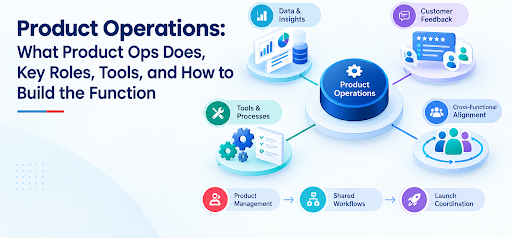
Product operations (product ops) is the function that enables a product management team to run smoothly at scale. It's the function that owns the processes, tools, data, and communication channels that the product managers use every day.
The aim is to free up the product managers to focus on strategy and customers, with product ops handling the operational 'nuts and bolts' underneath. It was early adopters such as Airbnb, Uber and Stripe that helped to popularise the concept, and it's now a fairly common practice across the software industry.
Key Highlights of Product Operations
- Product ops is a support function that's about improving how the product teams work rather than what they build.
- The function is built on four legs: data and insights, customer feedback loops, tools and processes and cross functional alignment.
- A Product Ops Manager standardises the workflows, manages the tech stack and keeps the teams aligned.
- A Product Ops Analyst generally deals with the data, the dashboards and the research support.
- Common tools are roadmapping tools, product analytics tools, feedback tools and collaboration tools.
- Most companies see the benefits of product ops once you've got a number of product teams working in parallel.
- Success is defined in terms of cycle time, data quality, feedback response and adoption of shared standards.
Introduction
Product management is now one of the most demanding jobs in business. The PM is expected to talk to customers, define the strategy, write the specs, analyse the data and co-ordinate engineering, design and marketing. That's a massive amount of work for one role.
As product organisations grow, the operational load grows even faster. Someone has to maintain the tools. Someone has to manage the customer feedback. Someone has to ensure that three different teams aren't each building the same dashboard in their own way. That's where product operations come in.
It's become quite popular as it solves a real problem. In scaling companies, the PM team often ends up spending far more time on coordination, reporting and tooling than they do on product thinking itself. Product ops takes on that operational burden so the PM team can get back to discovery, strategy and delivery.
In this guide you'll find out what product ops is, where it comes from and how it's different from both product management and program management. You'll also find out about the key roles, the tools and a practical plan for building the function in your organisation.
What Is Product Operations?
Product Ops is the discipline that enables a product organisation to scale effectively. It's the discipline that provides the product manager with the inputs they need to set strategy, prioritise and execute. Rather than own a product, Product Ops owns the systems that enable the product to work.
Think of it this way. The sales team has sales ops. The marketing team has marketing ops. The product team now has product ops. They all exist for the same reason really. As a team grows, its supporting infrastructure becomes a job in itself.
In practice product ops covers a very broad range of things. It's about standardising how the teams plan and communicate. It's about managing the product tech stack. It's about gathering and collating the customer feedback.
It also builds dashboards and reporting systems and coordinates the launches across functions. In the past product managers and team leads would have done all of that informally. Now that's the job of product ops.
Origins of Product Ops
Product Ops didn't just appear out of nowhere. It grew out of Sales & Marketing Ops when those functions became so complex that they required a dedicated Ops function to support them in terms of tooling, data and process.
The product was the same story. In the 2010s software companies were growing at a phenomenal rate. Product teams were multiplying, tool stacks were getting out of hand and data was all over the place in dozens of different systems. The product managers were completely consumed by the coordination work. The ad hoc, improvised way of working simply wasn't any more viable.
The function started to take shape in the period circa 2018-2020. Pendo for instance, kicked off their product ops function in the summer of 2019. Airbnb, Uber and Stripe were all well known examples of companies that had adopted the practice to support market expansion, customer feedback loops and launch coordination. In 2023 Melissa Perri and Denise Tilles published Product Operations which gave the discipline a common language and a common framework.
Product Ops is no longer just the preserve of the big tech companies. As organisations scale their digital product operations, product ops is now being adopted by mid-market companies, startups and indeed non-software businesses.
Product Ops vs Product Management vs Program Management
These three roles are very similar in sound but they actually answer different questions. It's important to understand the distinction as it will then enable you to staff and structure your product organisation appropriately.
Product management is about the what and the why. The PM owns the product, understands the customer's problems, defines the product strategy and then works with engineering to build the product. If you're new to the role then study this guide on responsibilities of a product manager.
Product Ops is all about the ‘how’ of the product organisation. It doesn't own any one product. It's about improving the processes, the tools and the information flow that every product manager relies on.
For a more detailed comparison, see the project management vs product management blog to understand how the responsibilities of adjacent roles are split.
Program management is about the coordinated delivery of a number of projects. The PM is responsible for the tracking of dependencies, timelines and risks across the portfolio. In many organisations there is a significant overlap between program management and product ops so clear ownership is important. We'll come back to that ownership issue later in the guide.
A related role is that of the Product Owner (from Scrum). The Product Owner is responsible for maximising product value, primarily via effective management of the backlog for the development team and being the clear voice of the stakeholders.
Why Product Operations Matters?
The value of product operations is very much apparent once you've got multiple product teams. Prior to that you can quite easily miss the need as a small team can just get on and do it informally. Once you've got multiple teams the friction is going to build up very quickly.
The cost of this friction is very real but you rarely see it on any dashboard. Meetings go on forever because the context exists in people's heads rather than in a shared document. Decisions get re-litigated because no one ever recorded why they were made.
Roadmap commitments slip not due to engineering delays at all but because the teams never actually defined the handoffs. Over time the very best product people burn out on the coordination work and the quality of product thinking across the organisation deteriorates.
Here's what changes as you scale.
1. Brings own toolset:
Each new product team brings its own toolset, its own definition of success and its own way of running meetings. Customer feedback comes in via five different systems. The execs are asking for numbers that two different teams are calculating in completely different ways.
2. Launches get delayed
Launches get delayed because marketing wasn't involved early enough. There's no one product manager who owns any of these issues, which is precisely why you need a dedicated owner.
Product Ops also protects one of the company's most valuable assets: product manager time. If the operational load isn't managed then senior product people are spending their days on admin glue rather than customer discovery and strategy. A good Product Ops function will get that time back.
For PLG (product-led growth) organisations the function is even more important. PLG relies on fast feedback loops, clean usage data and rapid experimentation and all of those things are predicated on the operational infrastructure that Product Ops provides.
Signs Your Team Needs Product Ops
Watch for these signals in your organization:
- Product managers spend more time on reporting and tooling than they do on the actual customer problems.
- Different teams define the same metric (active users, for example) in entirely different ways.
- Customer feedback is all over the place in support tickets, sales calls, spreadsheets and chat logs.
- Every team has its own version of the roadmap in a different format.
- New product managers take months to get up to speed as there's absolutely nothing documented.
- Launches regularly surprise Marketing, Sales or Support.
- Leadership ask a very simple question about product performance and get three very different answers.
If a few of those sound familiar then your organisation is probably ready for a Product Ops role.
Core Pillars of Product Operations
Most product ops functions will structure their work around four pillars. Taken together they form the operational foundation of a product organisation.
1. Data and Insights
The first pillar is making the data trustworthy and accessible. Product teams make decisions every day and the quality of those decisions is only as good as the quality of the data they're making decisions on.
Product Ops defines the standard metrics so that every team is measuring the same way. They build and maintain the dashboards that leadership can use. They ensure that tracking is implemented correctly across the product. If a PM asks 'how's that feature doing?' the answer should be available in minutes not days.
This pillar also encompasses business insights. Product ops will typically produce revenue, cost and usage analysis by product line so that the leadership team can make portfolio decisions. If you’re looking to build that capability, start with the core product metrics every team should share.
A product operations analyst will quite often be doing the hands on work of querying data, building reports and keeping the product analytics tools running.
2. Customer Feedback Loops
The second leg is customer feedback. All companies get feedback of some kind but the majority of them don't know what to do with it. Feedback comes in via support tickets, sales calls, app store reviews, user interviews and surveys. If you don't have a system in place then the patterns are invisible.
Product Ops builds that system. They gather the feedback in one place, tag it consistently and route it to the relevant product team. They then synthesise the themes for product managers, feeding directly into product discovery.
Closing the loop is just as important as gathering the input. Customers and internal teams need to know what's happened to their feedback. Product ops is the team that tracks that so it doesn't just vanish into a black hole.
3. Tools and Processes
The third leg is the product team's tech stack and their workflows. Modern product teams use a whole raft of tools: roadmapping tools, work tracking tools, documentation tools, analytics tools, feedback capture tools and collaboration tools.
Product Ops will evaluate and select the tools, negotiate with the vendors, manage the integrations and train the team on how to use them. Equally important is defining how the work moves through the tools. Who creates the roadmap item? What are the statuses? When does a feature go from discovery to delivery? These are process questions and having consistent answers across the organisation will make the whole thing run far more efficiently.
A well designed product management workflow removes the guesswork from those handoffs. Product ops is usually the owner and keeper of that workflow.
4. Cross-Functional Alignment
The fourth pillar is alignment across functions. Product work touches every function in the business: engineering, design, marketing, sales, support, finance and leadership. Each function has its own language, its own set of priorities and its own way of planning.
Product Ops is the bit of infrastructure that binds the various cross functional teams together. It runs the operating cadence (roadmap reviews, release planning, launch readiness checks, post launch readouts etc). It ensures that the GTM teams know what's coming and when. It's the bit that translates between the technical and the commercial.
Many product ops teams will use an operating model canvas to map the work out on a single page. The canvas will show strategy, processes, teams, tools and metrics all in one place, which makes the gaps and overlaps obvious. Study about product operating model for better understanding of product operations.
The Product Operations Manager Role
The Product Operations Manager is the key player in this area. The nature of the Product Ops role varies enormously depending on the size of the company. It could be a single individual, a small team or the head of a whole department.
Responsibilities
A product operations manager typically owns the following areas:
- Process design: the creation and improvement of the product management process from discovery through to launch and iteration.
- Data infrastructure: defining the metrics, maintaining the dashboards and ensuring data quality.
- Feedback systems: building the pipes that collect, organise and route the customer feedback.
- Tool administration: selecting, integrating and supporting the product management tools.
- Launch coordination: running the readiness checklists to ensure that every function is ready for the releases.
- Onboarding: training new product managers on the tools, templates and rituals.
- Communication: keeping our stakeholders up to date on any changes to the roadmap and the associated timelines.
- Reporting: giving leadership a consistent view of product performance.
In smaller companies the product ops manager does all of that themselves. In the larger organisations the role becomes more strategic and the execution is handled by analysts and specialists.
Skills
Strong product operations skills blend analytical, organizational, and interpersonal strengths. The most important ones:
- Data literacy: being comfortable with metrics, having a grasp of the basics of SQL and being able to use the various dashboard tools.
- Process thinking: the ability to map out the process and identify the bottlenecks.
- Communication: taking complex information and explaining it in a simple way to different audiences.
- Stakeholder management: about building relationships and influencing without any authority.
- Project coordination: balancing a number of workstreams and deadlines.
- Technical curiosity: the ability to learn new tools rapidly and to assess vendors effectively.
- Change management: introducing new processes without generating any resistance.
Lots of product operations managers come from adjacent roles actually (product manager, business operations analyst, program manager, product owner etc). Each of those roles provides a very solid basis for the prodops function.
Certification training can speed up the transition. The CSPO certification training builds the core backlog and stakeholder skills, the Advanced CSPO certification training builds on that and develops the strategic and leadership skills. Both are very practical ways of building up the skillset that product ops requires.
Product Operations Team Structure
How you set up Product Ops is going to be very much dependent on your size and maturity. There is no one right way.
Small Team vs Scaled Organization
In a small org product ops is typically one person, sometimes even a part time responsibility of a senior PM or COO. That one person is responsible for everything really: the tools, the data, the feedback, the process. It's all about the quick wins and getting rid of the most painful friction.
In a scaled up organisation product ops becomes a proper team. In some organisations the senior role is Head of Product Strategy and Operations which again reflects the degree of overlap between the two areas. A typical career path would be:
- Product Operations Analyst: data work, dashboards, documentation, tool support.
- Product Ops Manager: designs the processes, owns the tool stack and drives adoption.
- Head of Product Ops: sets the strategy for the function and works closely with Product Leadership.
Some large companies have a product ops person assigned to each product director, others run a central product ops team that serves all product directors. The central model has the advantage of consistency, the embedded model has the advantage of deeper support. Most organisations start out central and work their way towards a hybrid as they grow.
Organisations that have adopted agile in some form will typically have product ops linked into their planning system. If you're in the SAFe world then the SAFe POPM certification is the one that enables the product owners and managers to operate effectively within that model and that's something that product ops will often be involved in.
Product Operations Tools
Product Ops teams are responsible for evaluating and maintaining the tools that the product organisation uses. The table below shows the main categories.
| Category | What It Does | Examples | Selection Considerations |
| Roadmapping | Plans and communicates the product launch roadmap and timelines | Aha!, ProductPlan, airfocus | Ease of sharing with stakeholders and linking to delivery work |
| Work tracking | Manages backlogs, sprints, and delivery workflow | Jira, Linear, Azure Boards | Integration with roadmapping and analytics tools |
| Product analytics | Measures feature usage, retention, and funnels | Amplitude, Mixpanel, Pendo | Event tracking flexibility and self-service queries |
| Customer feedback | Collects and organizes feedback and feature requests | Canny, Productboard, UserVoice | Tagging, routing rules, and closing the loop with users |
| Documentation | Creates shared knowledge bases and specs | Confluence, Notion | Search, templates, and permission control |
| Research repository | Stores interviews and research findings | Dovetail, EnjoyHQ | Tagging and search across past research |
| Collaboration | Supports workshops and async planning | Miro, Figma, Slack | Integration with the rest of the stack |
| Dashboards and BI | Combines product and business data into reports | Tableau, Looker, Power BI | Data source connectors and access management |
The key to selecting the right product management tools is less to do with the brand name and more to do with fit. Start with the problems you're trying to solve, check that it integrates with your existing stack, and then check that the team will actually use it. That's typically the remit of product ops who will run the evaluation and make the final call.
How to Set Up Product Operations?
Building the function requires deliberate planning. A hasty rollout is exactly the kind of bureaucracy that product ops is supposed to eliminate. The sequence below works very well for most organisations.
First 90 Days Plan
- Days 1 to 30: Listen and diagnose. Meet every product manager and key stakeholder. Map out the current product management process from discovery through to launch. Document all the tools that are in use and their associated costs. Identify the top 3 sources of friction. Don't make any changes at this stage.
- Days 31 to 60: Get quick wins. Fix the most painful problems first (a broken dashboard, a totally chaotic feedback inbox, a missing launch checklist etc). Standardise one workflow end to end. Publish some simple templates for specs and roadmap items. Early wins build the trust you need to go on and do the bigger changes.
- Days 61 to 90: Build the foundation. Define the shared metrics and build the first standard dashboard. Set up a single feedback intake mechanism. Establish a regular operating rhythm (e.g. roadmap reviews, launch readiness checks). Document everything and set a baseline so you can measure improvement.
One of the early deliverables you should be looking at is a clear, shared roadmap. If you don't have one in place already then this blog explains what a product roadmap is and how to build a good one. A consistent roadmap format is often the first thing a product ops person will do.
Metrics for Product Ops
How do you know Product Ops is working? You measure both operational health and business outcomes. Define each metric before you start, and separate the OKRs and KPIs the function owns from those it only influences.
Operational metrics:
- Cycle time: how long the work takes from start to delivery.
- Time to insight: how long it takes to answer a product data question.
- Feedback response time: how quickly customer feedback is triaged and routed.
- Tool adoption: % of team members actively using the standard stack.
- Process compliance: percentage of launches that adhere to the readiness checklist.
Health indicators:
- Product manager satisfaction (as measured by survey).
- Onboarding time for new Product Managers.
- Launch quality: fewer missed dependencies and fewer surprises.
- Data trust: fewer disputes arising out of conflicting numbers.
Business outcomes of course are adoption, retention and revenue growth. All of these are things you want to track. The caveat is that product ops will have an influence on these outcomes but won't own them. Present them as context and use the operational and health metrics above to demonstrate the function's actual contribution.
Set a baseline prior to making any changes. Then track improvement against that baseline. Don't be fooling yourself into thinking you're going to get some arbitrary percentage gain. Your starting point is what will determine what a realistic level of improvement is.
Product Operations Challenges
Product ops fails in all sorts of ways. Two of the most common problems are:
Becoming Process Police
The most prevalent failure mode is the team becoming the process police. The function starts to police the process for its own sake rather than actually solving problems. The result is that product ops become an impediment rather than an enabler.
The fix is to be problem driven. Every process should be traceable back to a real pain point that someone actually felt. Keep the standards as light as possible and be very clear about why you have them. Prefer to enable rather than to enforce.
If a process ceases to be of any use then change it or get rid of it. Good product management best practice will be the stuff that actually helps the teams, not the stuff that's just mandated.
Unclear Ownership
The second issue is the murky boundaries with the adjacent roles. Product Ops, Program Management, Project Management and Chief of Staff all have areas of overlap. Without clear agreements in place you end up with work either getting missed completely or being done twice.
Solve this with a written ownership model (i.e. document who owns the data, who owns the process, who owns the tools, who owns the launches and who owns the cross team coordination). Review those boundaries on a quarterly basis and adjust as the organisation evolves. Product strategy and ops work best when everyone knows what they own.
Conclusion
Product Ops has definitely earned its place in the modern product org. It takes the invisible operational work that goes on behind the scenes of product development and turns it into a designed, measured and continually improving system. The end result is faster teams, cleaner data, better feedback loops and product managers who can actually get on with the customers and strategy.
If your product org is growing and feeling the friction then now is a good time to invest in product ops. Start small, listen first, deliver some quick wins and build from there. The ones that get it right find that product ops becomes the quiet engine of their product velocity.
For professionals it's also an emerging career path (product ops) which rewards the hybrid skillset of product thinking, data and process design. You get a real advantage if you go out and develop those skills deliberately as more and more organisations are moving to adopt the function.
Simpliaxis can help you build that foundation. The ICP-PDM product management training is the course that gets you ready for the ICAgile product management certification and covers the modern practices (from discovery through to delivery) that underpin product ops excellence. Take a look at the course, pick a schedule that works for you and take the next step in your product career with confidence.









 Lowest-Price Challenge












 Personalized Path



.webp)


 USA
 Canada
 India
 UK
 Australia
 Singapore


