


 Call Us




Toyota Production System (TPS): History, Pillars, Tools and Lessons

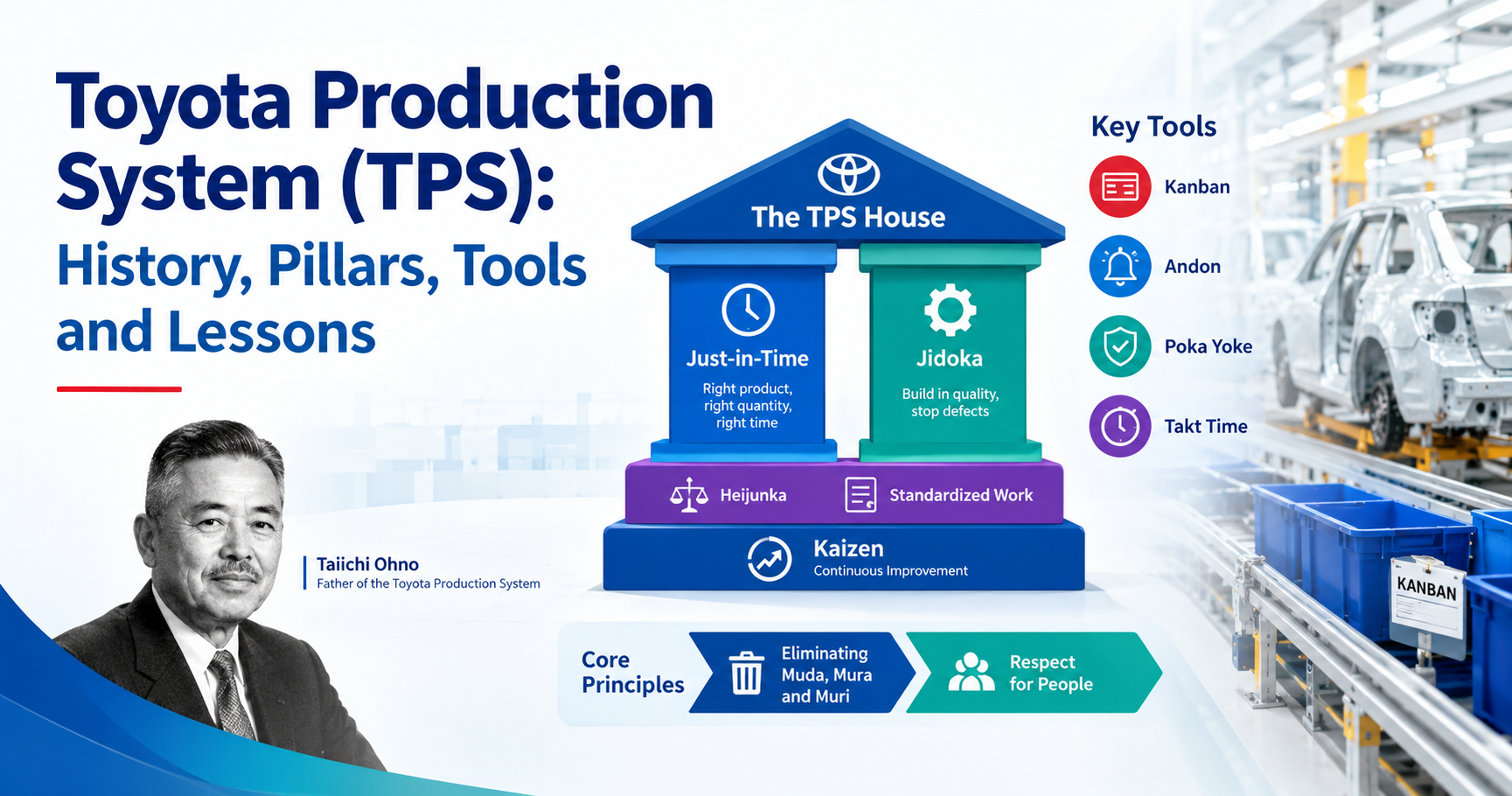
The Toyota Production System (TPS) is a management and manufacturing approach developed by Toyota to improve quality, reduce waste, control costs, and deliver products when customers need them. It is built on two core pillars: Just-in-Time (JIT), which ensures that only the required items are produced at the right time and in the right quantity, and Jidoka, which builds quality into processes by detecting abnormalities and stopping work when necessary. TPS also relies on Kaizen, standardized work, Kanban, and respect for people to support continuous improvement.
Key Highlights of Toyota Production System (TPS)
- The Toyota Production System aims to eliminate waste while improving product quality, productivity, and delivery performance.
- Its two fundamental pillars are Just-in-Time and Jidoka.
- Taiichi Ohno played a major role in developing and implementing TPS at Toyota after World War II.
- Core practices include Kaizen, Kanban, 5S, Poka Yoke, standardized work, and visual management.
- TPS addresses three types of operational problems: Muda (waste), Mura (unevenness), and Muri (overburden).
- The approach can be adapted to manufacturing, healthcare, logistics, and service operations.
- Successful implementation requires employee involvement, reliable processes, leadership support, and a culture of continuous improvement.
Introduction
What if a factory could produce exactly what customers need, identify defects before they spread, and improve its processes every day without relying on expensive technology alone? This is the central idea behind the Toyota Production System (TPS), one of the most influential approaches to operational excellence.
Developed at Toyota in Japan, TPS transformed the way manufacturers think about production, inventory, quality, and employee participation. Instead of measuring success only by the number of products manufactured, it emphasizes creating customer value while eliminating activities that consume resources without adding value.
The system became an important foundation for modern lean manufacturing. Its influence now extends beyond automotive production into healthcare, retail, software development, and supply chain management. Toyota itself reported producing approximately 9.05 million vehicles in fiscal year 2025, illustrating the scale of its global manufacturing operations. However, this figure represents Toyota's production volume, not a direct measurement of TPS's impact on productivity or cost savings.
Understanding TPS is valuable for professionals seeking to improve workflows, reduce operational bottlenecks, and build more reliable processes. Whether you manage a manufacturing line, a warehouse, or a service team, its underlying principles can help you identify problems and create sustainable improvements.
Let's explore the history, pillars, principles, tools, practical examples, and implementation challenges of the Toyota Production System.
What Is the Toyota Production System?
The Toyota Production System definition describes a management philosophy and set of operating practices designed to eliminate waste, improve quality, and deliver products efficiently in response to customer demand.
According to Toyota's official explanation of the Toyota Production System, its primary objective is to eliminate waste and shorten lead times so customers receive high-quality vehicles at a reasonable cost and as quickly as possible.
TPS does not simply mean producing more goods in less time. It focuses on improving the entire process, from sourcing materials to manufacturing, inspection, and delivery.
For example, imagine a factory producing 1,000 components daily when customers require only 700. Although the factory may appear productive, the additional 300 components consume materials, storage space, energy, and working capital. TPS encourages the organization to investigate why production exceeds demand and adjust the process accordingly.
The system combines two fundamental ideas:
- Just-in-Time: Produce and deliver what is needed, when it is needed, and in the quantity required.
- Jidoka: Detect abnormalities, stop when necessary, and prevent defective products from moving through the process.
These concepts work together to improve efficiency without sacrificing quality. TPS also emphasizes standardized work, continuous improvement, and employee participation.
For a broader understanding of the methodology, explore what is the lean process.
History and Taiichi Ohno
The roots of TPS can be traced to the Toyoda family's textile machinery business.
In the early twentieth century, Sakichi Toyoda developed automatic looms that could stop when a thread broke. This prevented defective fabric from being produced and reduced the need for constant human supervision. The concept later became an important foundation of Jidoka.
Toyota's automotive business introduced another essential idea through Kiichiro Toyoda, who advocated producing components just in time rather than maintaining excessive inventories.
Following World War II, Toyota faced limited resources, financial constraints, and the need to manufacture vehicles efficiently in smaller quantities and with greater product variety than traditional mass-production systems typically allowed.
This environment encouraged experimentation with more flexible production methods.
Taiichi Ohno, widely recognized as a key architect of TPS, helped develop these ideas into a coordinated production system. During the 1940s, 1950s, and 1960s, he worked to improve production flow, reduce overproduction, introduce Kanban practices, and establish systematic approaches to identifying waste.
Toyota gradually expanded these methods across its factories and supplier network. Outside Japan, the system gained wider recognition through research into lean production and manufacturing partnerships, including the NUMMI joint venture established in California in 1984.
The 1990 publication of The Machine That Changed the World, based on research by the Massachusetts Institute of Technology's International Motor Vehicle Program, helped popularize the term lean production.
Today, TPS continues to evolve alongside automation, digital manufacturing, and changing customer requirements.
For additional historical context, read about Taiichi Ohno and the Toyota Production System's development.
TPS vs Lean Manufacturing
TPS and lean manufacturing are closely related, but the terms are not identical in every context.
TPS refers specifically to the production philosophy and operating practices developed at Toyota. Lean manufacturing is a broader approach that applies similar principles to eliminate waste, improve flow, and maximize customer value across different organizations and industries
| Aspect | Toyota Production System | Lean Manufacturing |
| Origin | Developed at Toyota | Inspired by TPS and other improvement approaches |
| Primary focus | Production flow, quality, and waste elimination | Improving value delivery across manufacturing processes |
| Core concepts | Just-in-Time and Jidoka | Value, flow, pull, waste reduction, and continuous improvement |
| Typical tools | Kanban, Andon, standardized work, Kaizen | Value stream mapping ,Kanban, 5S, value stream mapping, Kaizen, and others |
| Application | Toyota and organizations adapting its operating philosophy | Manufacturers and other organizations across industries |
Both approaches encourage organizations to understand customer needs, reduce unnecessary activities, and improve processes continuously.
However, copying individual TPS tools does not automatically create a lean operating system. The underlying management practices, employee involvement, and problem-solving culture are equally important.
For a detailed comparison of related methodologies, see Lean Six Sigma vs Six Sigma.
The TPS House
The Toyota Production System is commonly illustrated as a house because its elements depend on one another.
The roof represents the desired outcomes: quality, cost efficiency, and fast delivery. The two supporting pillars are Just-in-Time and Jidoka. Standardized work, continuous improvement, and a stable production environment provide the foundation.
If one pillar is weak, the entire system becomes less effective. For example, reducing inventory without improving equipment reliability can cause frequent production interruptions. Similarly, producing quickly without detecting defects can increase rework and customer complaints.
Just-in-Time
Just-in-Time (JIT) is the practice of producing and delivering the right items in the right quantities at the right time.
Instead of manufacturing goods based only on forecasts or maximum machine capacity, a JIT system coordinates production with actual demand and the requirements of the next process.
Its main objectives include:
- Reducing excess inventory and storage requirements.
- Improving material and information flow.
- Shortening production lead times.
- Making production problems easier to identify.
- Avoiding unnecessary overproduction.
Consider an automobile assembly line that needs 100 seat assemblies during a scheduled production period. A well-coordinated JIT process arranges for the required quantity to arrive when it is needed rather than delivering hundreds of extra assemblies that occupy valuable floor space.
JIT does not mean eliminating every inventory buffer. Toyota's official description explains that minimum stocks may be positioned strategically so assembly can begin promptly and processes can replenish parts as they are consumed.
The objective is to maintain the smallest practical inventory that supports reliable operations, not to expose the business to avoidable shortages.
Successful JIT implementation depends on dependable suppliers, accurate scheduling, consistent quality, and effective communication.
Jidoka
Jidoka, often translated as automation with a human touch, means building quality into the process rather than relying exclusively on final inspection.
When a machine detects an abnormality, it can stop automatically. In a manually operated process, an employee may stop the line when a defect or other problem appears.
The purpose is to prevent defective products from continuing through production and to make problems visible so their causes can be investigated.
For example, suppose an assembly machine installs a bolt with insufficient torque. A sensor can identify the deviation and trigger an alert or stop the operation before the component reaches the next station.
Without this mechanism, the defect might remain undetected until final inspection or, worse, until the product reaches the customer.
Jidoka therefore combines automation, human judgment, and structured problem-solving. It encourages employees to address the source of an issue rather than repeatedly correcting its symptoms.
Learn more about this concept through the Lean Enterprise Institute's explanation of Jidoka.
Heijunka and Standardized Work
Heijunka means production leveling. It helps organizations reduce fluctuations in production volume and product mix rather than allowing demand peaks and scheduling changes to create excessive pressure on people and equipment.
Imagine a factory that receives orders for 500 units on Monday and 100 units on Tuesday. Producing everything in large batches may create inventory, overtime, and uneven workloads. Where demand patterns and capacity allow, leveling production across periods can make resource use more consistent.
Heijunka does not eliminate all demand variation. It helps organizations manage predictable fluctuations while maintaining flexibility for genuine changes in customer requirements.
Standardized work complements production leveling by documenting the safest and most effective known method for completing a task. It identifies the work sequence, expected timing, and necessary materials or inventory.
For instance, an assembly task might specify the sequence for fitting a component, tightening fasteners, and verifying the result. Employees follow the standard while identifying opportunities to improve it.
Standardized work is not intended to prevent innovation. It establishes a baseline against which improvements can be measured and adopted consistently.
Kaizen as the Foundation
Kaizen means continuous improvement through small, ongoing changes.
Rather than waiting for a major transformation project, teams regularly identify problems, test solutions, and evaluate the results. Employees who perform the work are encouraged to contribute because they often understand practical obstacles better than people observing the process from a distance.
A warehouse team, for example, might notice that workers repeatedly walk across the facility to collect packing labels. Moving the labels closer to the packing stations could reduce unnecessary movement and save time.
The team can measure walking distance or order-processing time before and after the change to determine whether the improvement worked.
Kaizen typically follows a structured problem-solving cycle: identify an issue, understand its cause, test a change, evaluate the outcome, and standardize successful results.
This approach connects closely with the Lean Six Sigma principles, which emphasize customer value, process improvement, and data-informed decisions.
Principles of Toyota Production System
The principles of Toyota Production System go beyond the use of specific tools. They establish how organizations identify waste, design processes, solve problems, and involve employees in improving performance.
TPS is not universally defined as a fixed list of seven principles. However, seven practical themes can help explain its broader philosophy.
- Define value from the customer's perspective.
- Understand and improve the entire value stream.
- Create smooth process flow.
- Use pull-based production to respond to demand.
- Pursue continuous improvement.
- Build quality into every process.
- Respect people and develop problem-solving capabilities.
These themes reflect established lean principles and TPS practices rather than an official, universally standardized list called the “7 principles of Toyota Production System.”
Eliminating Muda, Mura and Muri
TPS identifies three interconnected forms of operational inefficiency: Muda, Mura, and Muri.
Muda means waste: activities that consume resources without adding customer value. Taiichi Ohno's traditional classification identifies seven major wastes.
- Overproduction: Making more products than required.
- Waiting: Leaving employees, materials, or machines idle.
- Transportation: Moving materials unnecessarily.
- Overprocessing: Performing work that does not contribute meaningful value.
- Inventory: Holding more materials or products than necessary.
- Motion: Requiring unnecessary movement by employees.
- Defects: Producing items that require correction, rework, or disposal.
Many modern lean frameworks also recognize an eighth waste: failing to use employees' knowledge and abilities effectively.
For example, if a company manufactures 200 extra units each day to keep machines busy, it may increase storage costs and hide problems with scheduling. Reducing overproduction can reveal these issues and free resources for more valuable work.
Explore all seven categories in this guide to the seven wastes of lean.
Mura refers to unevenness in workload, demand, or production. Sudden increases in orders followed by long periods of inactivity can strain employees and create bottlenecks.
Muri means overburdening people or equipment. Examples include assigning unrealistic workloads, operating machinery beyond safe limits, or expecting employees to maintain unsustainable production speeds.
These problems often reinforce one another. Uneven schedules can lead to overburdening, which increases mistakes and creates waste.
TPS encourages organizations to balance workloads, improve scheduling, and design processes that support reliable performance without placing unnecessary strain on employees or equipment.
Respect for People
Respect for people is a fundamental part of TPS, not an optional addition to its technical practices.
Employees should have the opportunity to identify problems, suggest improvements, learn new skills, and contribute to decisions affecting their work. Managers are expected to understand actual operating conditions rather than relying entirely on reports.
The Japanese concept of genchi genbutsu, often translated as “go and see,” encourages decision-makers to visit the place where work happens and observe the problem directly.
For example, if order fulfillment regularly misses deadlines, a manager should examine the picking, packing, and dispatch processes before assuming that employees are working too slowly.
Direct observation may reveal poorly located inventory, unclear instructions, or an outdated software system.
Respect also involves providing safe working conditions, realistic workloads, adequate training, and support for employees who stop a process to report a problem.
When people can raise concerns without fear of blame, organizations are more likely to discover recurring issues and develop sustainable solutions.
Toyota Production System Tools
The Toyota Production System uses practical tools to make problems visible, control production, and improve consistency. These tools work best when they support clear objectives rather than being introduced simply because they are associated with lean manufacturing.These tools sit alongside the wider set of Lean Six Sigma tools used across improvement projects.
Kanban
Kanban is a visual signaling method used to control the movement and replenishment of materials or work.
In TPS, Kanban supports a pull system: the downstream process signals what it needs, and the preceding process replenishes that quantity. This helps prevent production from exceeding actual requirements.
A simple Kanban card might identify a component, its quantity, the location where it is used, and the point where it should be replenished.
For example, a factory may use a container holding 20 components. When the container is emptied, its Kanban signal authorizes the replenishment of another container according to established rules.
The signal connects consumption with production and helps control work-in-progress inventory.
Kanban can also be digital, using software dashboards or electronic signals instead of physical cards. Regardless of format, its effectiveness depends on clear rules, reliable replenishment, and appropriate limits on work-in-progress.
Read more about the core practices of Kanban.
Andon
Andon is a visual or audible signaling system that alerts the team when a problem occurs.
An Andon display may use colored lights, screens, or alarms to indicate equipment faults, quality issues, material shortages, or production delays.
For example, if an employee discovers that a component does not fit correctly, they can activate an Andon signal to request assistance. The designated team responds, investigates the problem, and determines whether production should continue.
Andon makes abnormalities visible instead of allowing them to remain hidden until the end of a shift.
However, the signal itself does not solve the problem. Organizations need clear response procedures, trained personnel, and a culture in which employees can raise concerns without being penalized for reporting genuine issues.
Poka Yoke
Poka Yoke, or mistake-proofing, refers to designing a process so that errors are prevented or detected immediately.
The objective is to make correct work easier and mistakes harder to commit.
Examples include:
- A connector that fits only in the correct orientation.
- A machine that will not operate until a safety guard is closed.
- A digital form that identifies missing mandatory fields before submission.
- A fixture that prevents a component from being installed backward.
Suppose an employee must install four bolts on a component. A poorly designed process may allow the employee to overlook one bolt. A mistake-proofing mechanism could detect the missing fastener or prevent the next operation until all four are verified.
Poka Yoke is particularly useful when mistakes are repetitive, expensive, or difficult to detect later.
The best solution addresses the process design rather than depending entirely on employees to remember every instruction.
Takt Time
Takt time represents the pace at which a process must produce a unit to meet customer demand.
It is calculated by dividing the available production time by the required number of units.
Formula:
Takt time = Available production time ÷ Customer demand
For example, suppose a factory has 420 minutes of available production time per shift and must produce 140 units.
Takt time = 420 ÷ 140 = 3 minutes per unit.
The process must therefore deliver one unit every three minutes, on average, to meet the demand target.
Takt time is different from cycle time. See lead time vs cycle time for how these flow measures relate.
If a workstation takes four minutes to complete a unit when takt time is three minutes, it may become a bottleneck. The team can investigate task allocation, equipment performance, material availability, or unnecessary steps.
Takt time helps align production capacity with customer requirements, but it should not be used to justify unsafe workloads or unrealistic expectations.
Toyota Production System Examples
The following Toyota Production System examples demonstrate how the underlying concepts can be adapted to different operating environments.
TPS in Manufacturing Beyond Toyota
Although TPS originated in Toyota's automotive operations, its principles can be adapted to other manufacturers.
Consider a furniture manufacturer that produces tables, chairs, and storage units. Under a traditional batch-based approach, the company might manufacture large quantities of each product and store them until orders arrive.
This can create excess inventory, occupy warehouse space, and delay the identification of defects.
A TPS-inspired approach could introduce several improvements:
- Pull production: Schedule work according to confirmed demand and appropriate replenishment signals.
- Kanban: Replenish screws, hinges, and other frequently used components when their consumption triggers a signal.
- Standardized work: Establish consistent assembly sequences and quality checks.
- Poka Yoke: Use fixtures that prevent panels from being installed in the wrong orientation.
- Kaizen: Ask employees to identify unnecessary movements and recurring delays.
The manufacturer should measure results using indicators such as lead time, defect rates, inventory levels, and on-time delivery. Improvements should be verified with actual operational data rather than assumed to produce a particular percentage of savings.
TPS can also help electronics manufacturers reduce assembly errors, food producers coordinate packaging with demand, and machine shops identify recurring equipment problems.
The central lesson is that the tools can vary, but the goal remains consistent: improve the process while reducing waste.
TPS in Healthcare and Services
TPS principles are not limited to factories. Healthcare organizations and service providers can also benefit from improved workflow, visual management, and structured problem-solving.
Consider a hospital emergency department where patients experience long waits because registration, triage, testing, and consultation are poorly coordinated.
A TPS-inspired improvement project might begin by mapping the patient journey and measuring waiting times at each stage.
The team could then identify unnecessary paperwork, duplicated data entry, missing supplies, or scheduling bottlenecks.
Possible solutions include standardized handover procedures, visual indicators for pending tests, improved supply replenishment, and clearer responsibility for each process step.
Similarly, a bank could use process mapping to reduce delays in loan applications, while an e-commerce business could introduce visual workflow limits to prevent orders from accumulating in the packing stage.
Healthcare applications require particular care: patient safety, clinical judgment, privacy, and necessary emergency capacity must never be compromised to reduce costs or waiting times.
The broader lesson is that TPS can improve services when teams focus on customer or patient value, reliable processes, and the removal of avoidable delays.
Problems With Toyota Production System Adoption
Despite its benefits, TPS is not a quick fix. Organizations that adopt isolated tools without addressing their operating culture may experience limited results or create new problems.
Common implementation challenges include:
- Resistance to changes in established working practices.
- Inconsistent supplier quality or delivery reliability.
- Insufficient training in problem-solving methods.
- Pressure to reduce inventory before processes are stable.
- Overemphasis on output targets at the expense of quality and safety.
- Treating improvement as a short-term project instead of an ongoing responsibility.
One particularly important risk is implementing Just-in-Time without appropriate safeguards.
Lower inventory can reduce storage costs, but it can also leave a business vulnerable to supplier disruptions, transportation delays, equipment failures, and sudden demand changes. Organizations should assess these risks and determine where strategic buffers or alternative supply arrangements are necessary.
Another challenge is measurement. A factory may celebrate higher machine utilization while ignoring the additional inventory or defects that the increase creates. TPS encourages organizations to assess the performance of the overall value stream rather than optimizing individual departments at the expense of the whole system.
Leaders should establish clear objectives, track baseline performance, involve employees, and evaluate improvements using reliable data.
For a structured approach to identifying and correcting operational inefficiencies, explore process improvement.
Cultural Barriers
Cultural barriers can be more difficult to address than technical challenges.
Employees may hesitate to report problems if previous managers blamed people for mistakes. Supervisors may resist stopping production because they are evaluated primarily on output. Departments may also protect their own performance indicators rather than cooperating to improve the entire process.
For example, a production manager rewarded only for meeting daily output targets might discourage employees from stopping a line to investigate a quality issue. Although output could remain high in the short term, defects might continue into later stages and become more expensive to correct.
Successful TPS adoption requires leaders to reward problem identification, encourage collaboration, and treat mistakes as opportunities to understand process weaknesses.
Training should explain not only how to use tools such as Kanban and Andon, but also why they matter and how employees can apply them.
Organizations should start with a manageable pilot, demonstrate measurable results, learn from implementation challenges, and expand successful practices gradually.
Most importantly, continuous improvement must become part of everyday management rather than an initiative that disappears when attention shifts elsewhere.
How TPS Connects to Lean Six Sigma Green Belt
The Toyota Production System and Lean Six Sigma share a common objective: improve process performance while eliminating activities that do not add value.
TPS emphasizes waste elimination, continuous improvement, standardized work, and built-in quality. Lean Six Sigma combines these ideas with structured problem-solving and statistical methods to reduce defects, variation, and process inefficiency.
A Lean Six Sigma Green Belt professional can apply these approaches to projects such as reducing manufacturing defects, shortening order-processing times, improving inventory control, or increasing service reliability.
For example, a distribution center experiencing frequent picking errors could use TPS principles to standardize picking procedures and improve visual controls. A Green Belt project could complement these changes by using the DMAIC methodology—Define, Measure, Analyze, Improve, and Control—to identify root causes, test improvements, and monitor results.
The two approaches are complementary, not interchangeable. TPS provides a broader operating philosophy, while Lean Six Sigma offers additional analytical and project-management methods for solving defined performance problems.
Professionals interested in developing these capabilities can explore Lean Six Sigma Green Belt certification and prepare with a Lean Six Sigma Green Belt practice test.
Understanding what Six Sigma is can also help professionals recognize how statistical analysis complements the process-focused thinking behind TPS.
Conclusion
The Toyota Production System demonstrates that operational excellence depends on more than speed, automation, or cost reduction. It requires a coordinated approach to eliminating waste, building quality into processes, responding to customer demand, and empowering employees to improve their work.
Its two pillars, Just-in-Time and Jidoka, provide the foundation. Practices such as Kanban, Andon, Poka Yoke, standardized work, Heijunka, and Kaizen help organizations put the philosophy into action.
However, adopting these tools alone is not enough. Sustainable results require leadership commitment, reliable processes, employee participation, and a willingness to investigate problems instead of hiding them.
Whether applied in manufacturing, healthcare, logistics, or service delivery, TPS offers a practical way to improve performance through systematic learning and continuous improvement.
For professionals pursuing operational excellence, understanding TPS also provides a strong foundation for exploring lean principles and Lean Six Sigma methods. The most important lesson is simple: improve the process, respect the people doing the work, and make progress one meaningful change at a time.







 Lowest-Price Challenge












 Personalized Path



.webp)


 USA
 Canada
 India
 UK
 Australia
 Singapore


