

 Combo Courses
 Call Us





_1730268805.png)







_1763641894.png)







_1751519626.webp)









_1730208711_1744091896_1761738442.webp)
_1730208753_1744092007_1761742400.webp)












































_1782982795.png)











_1782981113.png)








_1730269739.png)

_1738237575.png)






























_1733741106.png)






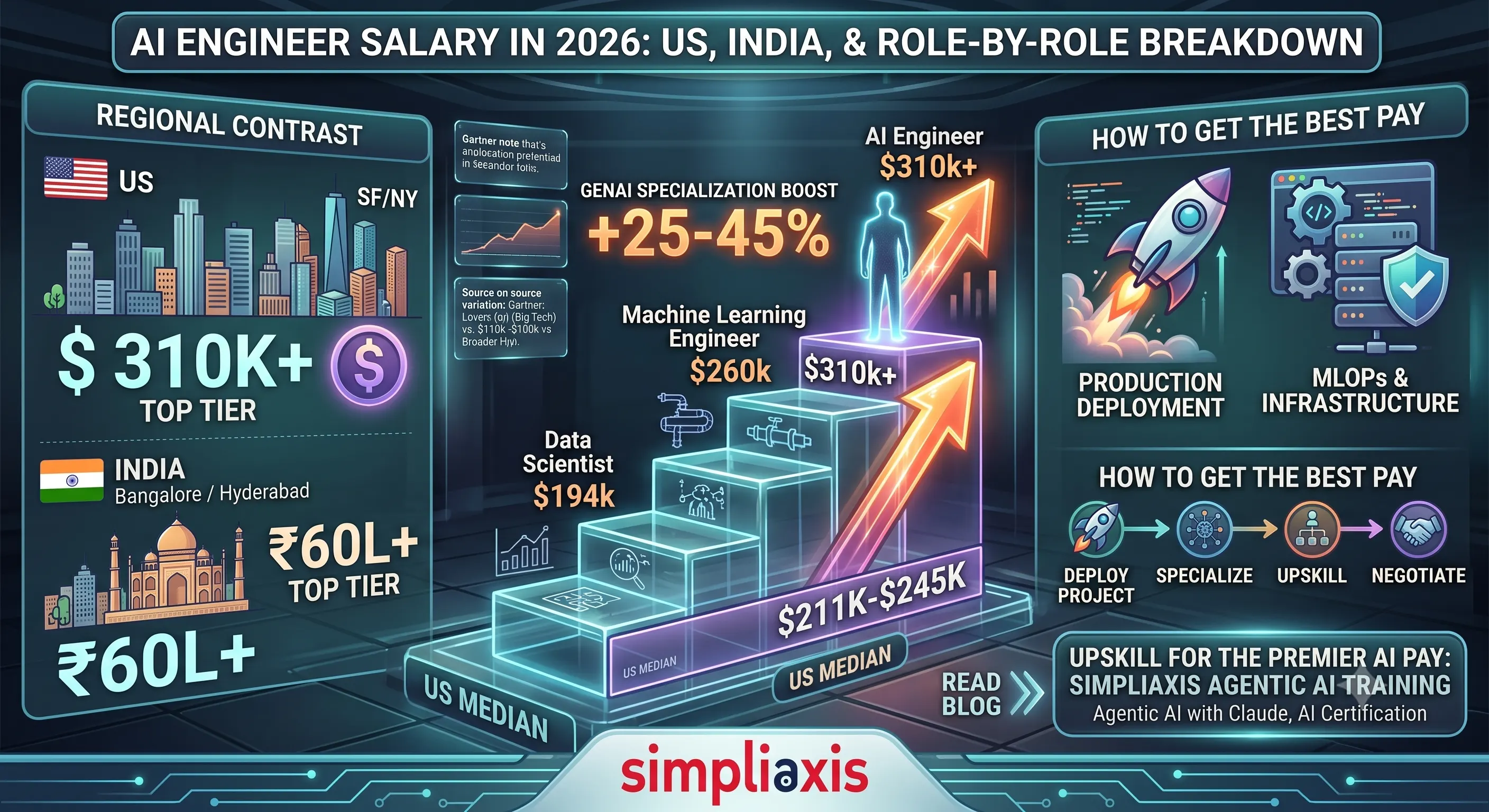
Table of Contents
- Quick Answer
- Key Highlights of AI Engineer Salary
- What Does an AI Engineer Actually Do
- AI Engineer Salary in the United States
- AI Engineer Salary in India
- AI Engineer vs Machine Learning Engineer vs Data Scientist Pay
- Why GenAI and LLM Specialists Earn a Premium
- Skills That Move the Salary Needle
- How to Increase Your AI Engineer Salary
- Frequently Asked Questions
- Key Takeaways
Quick Answer
AI engineer salaries in 2026 vary enormously by region, seniority, and specialization. In the US, total compensation typically ranges from roughly $145,000 for early-career roles to $300,000 or more at senior levels and top tech companies, with self-reported aggregate data putting the median closer to $211,000 to $245,000. In India, salaries range from roughly ₹6-8 lakh for freshers to ₹40-60 lakh or more for senior AI architects and specialists. Generative AI and LLM-focused specialists command a meaningful premium, often 25 to 45 percent above generalist AI engineering pay at the same experience level, because production-grade GenAI skills remain scarce relative to demand.
Key Highlights of AI Engineer Salary
- US AI engineer total compensation is commonly reported in the $145,000 to $310,000 range depending on level, with self-reported databases showing a median around $211,000 to $245,000.
- Big Tech-skewed data sources like Levels.fyi report notably higher figures than broader market surveys like Glassdoor, since Levels.fyi's sample leans heavily toward large tech employers with equity-heavy packages.
- Indian AI engineer salaries range from roughly ₹6-8 LPA for freshers to ₹40-60+ LPA for senior architects and specialists, with Bangalore paying the highest average base among Indian cities.
- GenAI, LLM engineering, and MLOps specializations carry a 20 to 45 percent salary premium over generalist AI engineering roles at comparable experience levels.
- AI engineers with strong production software engineering skills (deployment, scaling, monitoring) generally out-earn data scientists at equivalent seniority, since building reliable production systems is a scarcer skill than model experimentation alone.
- Compensation for AI-related roles has been notably volatile year to year, with reported swings of over 20 percent in median total pay within a single year as hiring demand fluctuates.
What Does an AI Engineer Actually Do
"AI engineer" is a relatively new, still-settling job title that generally sits between a data scientist and a software engineer. Rather than primarily researching and training models from scratch (a data scientist's typical focus), an AI engineer is usually responsible for integrating existing foundation models and machine learning systems into production applications: building APIs around models, managing inference costs and latency, implementing retrieval-augmented generation (RAG) pipelines, and monitoring model performance once deployed. This production-facing responsibility is a major reason AI engineer compensation has climbed quickly relative to more research-oriented roles.
AI Engineer Salary in the United States
| Level | Typical Total Compensation Range |
|---|---|
| Entry-level (0-2 years) | $100,000-$150,000 |
| Mid-level (3-5 years) | $140,000-$200,000 |
| Senior (6+ years) | $200,000-$310,000+ |
Sources diverge meaningfully depending on their sample. Levels.fyi, whose self-reported data skews toward large technology companies with substantial equity compensation, has reported median total pay fluctuating between roughly $228,500 and $295,000 within a single recent year, reflecting real volatility in AI hiring demand rather than measurement error. Broader market surveys that include a wider mix of company sizes tend to report somewhat lower medians. Job seekers should weigh offers against the specific company type and total compensation structure (base, bonus, equity) rather than any single aggregate figure.
AI Engineer Salary in India
| Level | Typical Annual Salary (LPA) |
|---|---|
| Fresher / Entry-level | ₹6-8 LPA (up to ₹12-15 LPA with strong GenAI project experience) |
| Mid-level (4-6 years) | ₹10-20 LPA |
| Senior / Lead / Architect | ₹25-60 LPA+ |
Bangalore reports the highest average AI engineer base pay among Indian cities, though Hyderabad offers comparable senior-level compensation with a notably lower cost of living, which affects real purchasing power more than the headline salary figure alone.
AI Engineer vs Machine Learning Engineer vs Data Scientist Pay
| Role | Typical US Base Range | Primary Focus |
|---|---|---|
| Data Scientist | $90,000-$194,000 | Analysis, experimentation, statistical modeling |
| Machine Learning Engineer | $128,000-$260,000 | Building and productionizing ML models and pipelines |
| AI Engineer | $140,000-$230,000+ | Integrating foundation models and LLMs into production applications |
The pattern across all three roles is consistent: compensation rises with the proportion of production software engineering responsibility in the role, not just modeling or analysis skill. This is sometimes described as a "production premium," and it is the main reason AI and ML engineering roles tend to out-earn data science roles with similar years of experience.
Why GenAI and LLM Specialists Earn a Premium
Within AI engineering itself, generalist roles pay less than specialized ones. Engineers focused specifically on large language model integration, retrieval-augmented generation, and agentic workflows reportedly earn 25 to 40 percent more than generalist ML engineers, while MLOps specialists (responsible for deployment infrastructure, monitoring, and reliability) earn roughly 20 to 35 percent more than generalist peers. This premium reflects genuine scarcity: the pool of engineers with real production experience shipping LLM-based systems remains small relative to how quickly companies are trying to adopt generative AI.
Skills That Move the Salary Needle
- Production deployment experience: shipping and maintaining a model or LLM-based feature in a live product, not just a notebook demo.
- RAG and agentic system design: building retrieval pipelines and multi-step agent workflows that use LLMs reliably at scale.
- MLOps and infrastructure: monitoring, versioning, and scaling ML systems in production environments.
- Strong software engineering fundamentals: the ability to write maintainable, tested, production-grade code, which increasingly matters more than deep model-training theory for most AI engineering roles.
- Cloud platform expertise: hands-on experience with the AI and ML services of a major cloud provider, since most production AI workloads run on cloud infrastructure.
How to Increase Your AI Engineer Salary
- Build and document at least one project that goes beyond a notebook, something deployed, monitored, and actually used, since interviewers increasingly probe for production experience specifically.
- Specialize deliberately in a high-demand niche (LLM integration, RAG, or MLOps) rather than staying a broad generalist, since the data consistently shows a specialization premium.
- Pursue structured, hands-on training rather than passive courses; Simpliaxis's Agentic AI Engineering with Claude training and its broader Artificial Intelligence certification course are built around applied, project-based learning rather than theory alone.
- Negotiate on total compensation, not just base salary, especially at companies where equity or bonus makes up a significant share of senior-level pay.
- Track your target companies' actual compensation bands using multiple sources (not just one salary database) before entering negotiations, since single-source figures can be skewed by sample bias.
Key Takeaways
- US AI engineer total compensation in 2026 spans roughly $145,000 to $310,000+ depending on level and company type, with meaningful variance between data sources.
- Indian AI engineer salaries range from ₹6-8 LPA for freshers to ₹40-60+ LPA for senior architects and specialists.
- AI engineers generally out-earn data scientists at similar experience levels due to a consistent "production premium" for engineering responsibility.
- GenAI, LLM, and MLOps specializations carry a real, measurable salary premium over generalist AI/ML roles.
- Deliberate specialization plus demonstrable production project experience move compensation more reliably than credentials alone.
Schema recommendation: Implement Article and FAQPage structured data for this page. Facts that could not be independently verified: the specific salary figures cited are aggregated from multiple third-party salary-tracking platforms and self-reported compensation databases current as of 2026 rather than a single authoritative government wage survey (such as the US Bureau of Labor Statistics, which does not yet track "AI engineer" as a distinct occupational category); actual compensation varies significantly by company, and readers should treat all figures here as directional benchmarks rather than guarantees.










 Lowest-Price Challenge











 Personalized Path


.webp)


 USA
USA  Canada
 India
India UK
UK Australia
 Singapore


