


 Combo Courses
 Call Us

_1787816079.png)
_1730268805.png)
_1763641894.png)
_1751519626.webp)
_1730208711_1744091896_1761738442.webp)
_1730208753_1744092007_1761742400.webp)

_1782982795.png)
_1782981113.png)
_1730269739.png)
_1738237575.png)
_1733741106.png)





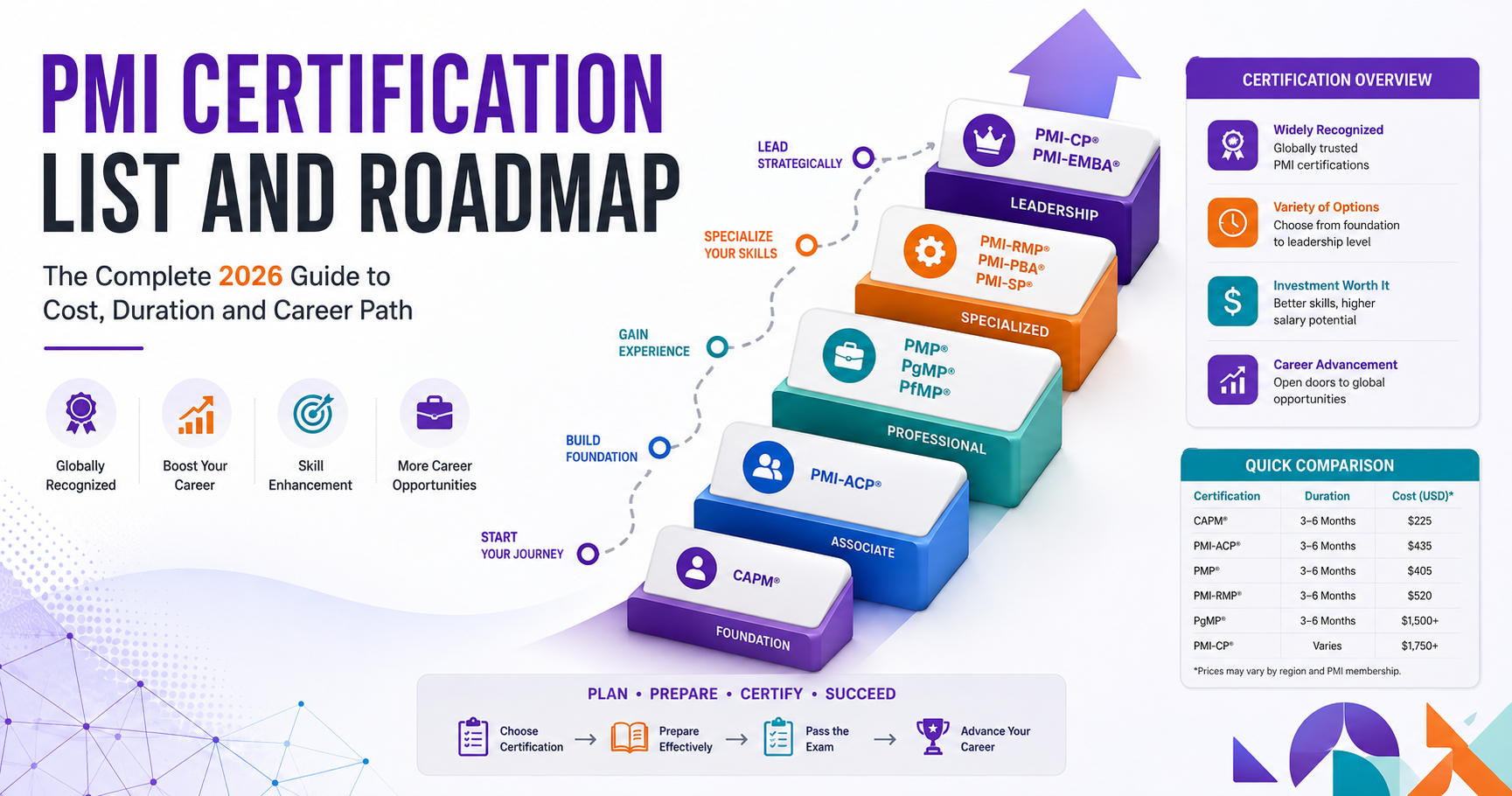
PMI, the Project Management Institute, offers 12 active certifications, from the entry-level CAPM to the senior-level PfMP and the newly absorbed PMI-CPMAI for AI project management. As of August 6, 2026, the PMP exam costs 445 US dollars for PMI members and 675 US dollars for non-members, according to StormWind Studios. Total certification cost, including required training hours, typically runs between 900 and 2,600 US dollars for the PMP alone. The right certification depends on experience: CAPM suits beginners with under three years in the field, PMP suits practicing project managers, PMI-ACP suits agile teams, and PgMP or PfMP suit senior program and portfolio leaders. The main tradeoff is that higher-tier PMI credentials demand years of documented experience before you can even apply, so the roadmap matters as much as the fee schedule.
Key Highlights of PMI Certification List
- PMI raised the PMP exam fee on August 6, 2026, to 445 US dollars for members and 675 US dollars for non-members, a 120 to 270 dollar jump from the prior 2025 pricing.
- PMI-ACP costs 435 US dollars for members and 495 US dollars for non-members, and requires 21 contact hours of agile-specific training before you can even apply.
- CAPM remains PMI's cheapest credential at 225 US dollars for members and 300 US dollars for non-members, and it now carries a 5-year validity instead of 3.
- PMI-RMP, the risk management specialization, costs roughly 520 US dollars for members and 670 US dollars for non-members, per Invensis Learning's 2026 fee data.
- PMI membership costs 139 to 164 US dollars a year and cuts every PMI exam fee by 150 to 250 dollars, so joining before you register almost always pays for itself.
- PMI-CPMAI, PMI's Certified Professional in Managing AI, has become the fastest-growing PMI credential in 2026 as organizations push generative AI into project delivery.
PMI Certification List and Career Roadmap
A PMI certification is a professional credential issued by the Project Management Institute, and PMI currently maintains 12 active certifications across project, program, portfolio, agile, risk, business analysis, construction and AI management. Choosing the wrong one wastes months of documented experience and hundreds of dollars in exam fees you cannot get back. This guide lays out the full PMI certification list, the realistic cost of each one in 2026, and a roadmap that matches credentials to where you actually stand in your career.
PMI adjusted its flagship PMP exam fee on August 6, 2026, pushing the member rate from 405 to 445 US dollars and the non-member rate from 555 to 675 US dollars, according to StormWind Studios' 2026 fee tracker. That single change reshuffled the math for anyone comparing PMI membership against a one-time non-member payment, and it is a useful reminder that PMI revises its fee schedule most years. Every number below reflects the most recent publicly reported figures as of September 2026, but PMI is the only authoritative source for the fee you will actually pay, so confirm the live number at pmi.org before you submit payment.
This matters right now because employers are asking for named PMI credentials in job postings more than ever, not just "PM experience." Whether you are a fresh graduate weighing the CAPM, a working project manager deciding between PMP and PMI-ACP, or a program director eyeing PgMP, the sections below walk through exam duration, training hours, exam fees, renewal fees and membership cost for every credential on PMI's current list.
What Is PMI Certification?
PMI certification is a credential awarded by the Project Management Institute, a US-based nonprofit professional association founded in 1969, after a candidate meets specific education and experience requirements and passes a proctored exam. PMI does not certify companies or courses; it certifies individuals, and it revokes credentials if a holder fails to complete the required renewal cycle.
The Project Management Institute's full form is exactly that: Project Management Institute. PMI is headquartered in Pennsylvania, United States, and it publishes the Project Management Body of Knowledge, commonly called the PMBOK Guide, which underpins the PMP and CAPM exam content. PMI also owns the Agile Practice Guide, which underpins PMI-ACP, and it maintains a public PMI certification registry where anyone can verify whether a named individual holds an active credential.
PMI certifications fall into five broad families: project management (CAPM, PMP), program and portfolio leadership (PgMP, PfMP, PMI-PMOCP), specialized practice areas (PMI-RMP, PMI-SP, PMI-PBA, PMI-CP), agile and adaptive delivery (PMI-ACP, Disciplined Agile), and the newest addition, AI-enabled project management (PMI-CPMAI). We will cover the cost and roadmap position of each below.
PMI Certification List: Every Credential PMI Offers in 2026
Certification | Full Name | Best For | Typical Experience Needed |
| CAPM | Certified Associate in Project Management | Students and career switchers with no PM experience | None; 23 hours of PM education |
| PMP | Project Management Professional | Practicing project managers leading teams | 36 to 60 months leading projects |
| PMI-ACP | PMI Agile Certified Practitioner | Scrum masters, product owners, agile coaches | 2,000 hours general PM plus 1,500 hours agile |
| PMI-RMP | PMI Risk Management Professional | Risk officers and PMs owning project risk registers | 3,000 to 4,500 hours risk management experience |
| PMI-SP | PMI Scheduling Professional | Planners and schedulers using critical path methods | 3,000 to 5,000 hours scheduling experience |
| PMI-PBA | PMI Professional in Business Analysis | Business analysts bridging requirements and delivery | 4,500 to 7,500 hours BA experience |
| PgMP | Program Management Professional | Leaders managing multiple related projects | 4 to 11 years program-level experience |
| PfMP | Portfolio Management Professional | Executives governing multiple programs and portfolios | 8-plus years portfolio experience |
| PMI-CP | PMI Construction Professional | Construction project and site managers | Construction-specific PM experience |
| PMI-PMOCP | PMI PMO Certified Professional | PMO leads and PMO analysts | PMO operating experience |
| PMI-CPMAI | PMI Certified Professional in Managing AI | PMs and analysts leading AI or generative AI projects | No PMI prerequisite; foundational AI/data literacy recommended |
| Disciplined Agile (DASM/DASSM) | Disciplined Agile Senior Scrum Master and Scrum Master | Teams scaling agile across the enterprise | Varies by track |
Pearson VUE, PMI's exclusive exam delivery partner, lists PMP, CAPM, PgMP, PfMP, PMI-ACP, PMI-CP, PMI-PBA, PMI-RMP, PMI-SP, PMI-PMOCP, PMI-CPMAI and the Certified Green Project Manager as the certifications currently administered under the PMI umbrella. That is the definitive PMI certification list as of 2026, and it spans every seniority level from entry-level associate to executive portfolio leadership.Two credentials deserve a quick clarification because search behavior around them is often confused. "PMP certification from PMI" and "PMI PMP certification" describe the exact same credential; PMP is simply the PMI certification most people mean when they say "project management certification" without qualifying it. Likewise, "PMI-CPMAI" is frequently searched as "PMI generative AI certification" or "PMI AI certification," and while CPMAI does cover generative AI use cases inside its curriculum, its formal scope is AI and machine learning project management broadly, not generative AI alone.
PMI Certification Roadmap: Which Credential Fits Your Career Stage
A PMI certification roadmap should follow your actual project experience, not the other way around. Below is the sequence Simpliaxis recommends to candidates who ask how to get PMI certification without wasting an attempt on a credential they are not yet eligible for.
Stage 1: Entry Level, Zero to 3 Years
If you are a student, a recent graduate, or a career switcher with no formal project leadership experience, start with the CAPM certification. It requires no professional experience, just a secondary degree and 23 hours of project management education, which you can complete through an authorized training partner such as Simpliaxis's CAPM Certification Training. CAPM also counts toward the 35 contact hours PMP eventually requires, so it is not a detour, it is a documented head start.
Stage 2: Practicing Project Manager, 3 to 5 Years
Once you have led project tasks or full projects for 36 to 60 months, depending on your degree level, the PMP certification becomes the standard move. PMP is what most job postings mean by "PMI certification required," and it remains the single most recognized credential in the profession. Pair it with Simpliaxis's PMP Certification Training Course, which bundles the mandatory 35 contact hours with exam simulation.
Stage 3: Agile and Hybrid Delivery
If your organization runs Scrum, Kanban, SAFe, or a hybrid delivery model, the PMI-ACP certification demonstrates agile-specific competency that PMP alone does not test deeply. PMI-ACP requires 2,000 hours of general project experience plus 1,500 hours specifically on agile teams, on top of 21 contact hours of agile training such as Simpliaxis's PMI-ACP Certification Training Course.
Stage 4: Specialist Tracks
Three specialist credentials let you go deep instead of broad. PMI-RMP suits anyone who owns a project risk register full time. PMI-SP suits dedicated schedulers running critical path and resource-leveling models. PMI-PBA suits business analysts who spend more time on requirements elicitation than on task sequencing. All three assume you already hold significant hands-on experience in that specific discipline, not just general PM exposure.
Stage 5: Program and Portfolio Leadership
PgMP and PfMP sit at the top of PMI's traditional ladder. PgMP is for professionals coordinating multiple related projects toward one strategic outcome, and PfMP is for executives governing entire portfolios of programs and projects across an organization. Both require a multi-panel review of your application before you are even approved to sit the exam, which is a materially heavier process than PMP's document-and-audit model.
Stage 6: The AI Era
PMI-CPMAI is the newest entrant and the fastest-growing search category in this space, covering PMI certification cost topics like "pmi generative ai certification cost" and "pmi ai project management certification." PMI absorbed the CPMAI credential, originally built by Cognilytica, to formalize how project managers plan, govern, and deliver AI and machine learning initiatives, including generative AI pilots. Unlike PMP or PgMP, it does not require years of PMI-specific experience, which makes it accessible to PMs pivoting into AI delivery right now.
Roadmap in one sequence:
- CAPM if you have no PM experience yet.
- PMP once you clear the experience threshold for your degree level.
- PMI-ACP if your teams run agile or hybrid delivery.
- PMI-RMP, PMI-SP or PMI-PBA if you specialize in risk, scheduling or business analysis.
- PgMP or PfMP once you lead multiple programs or full portfolios.
- PMI-CPMAI at any stage where your projects now involve AI or generative AI systems.
PMI Certification Cost 2026: Exam Fees, Training Fees, Renewal Fees and Membership
PMI certification cost is not one number, it is four separate line items: the exam fee, the mandatory training hours, PMI membership, and the renewal fee you pay every 3 to 5 years to keep the credential active. The table below lines up the exam fee, renewal fee and validity period for every major PMI certification, in US dollars, as reported across multiple 2026 fee trackers.
Certification | Member Exam Fee | Non-Member Fee | Renewal Fee | Validity |
| PMP | $445 | $675 | $60 member / $150 non-member | 3 years |
| CAPM | $225 | $300 | $150 member / $200 non-member | 5 years |
| PMI-ACP | $435 | $495 | $60 member / $150 non-member | 3 years |
| PMI-RMP | ~$520 | ~$670 | $60 member / $150 non-member | 3 years |
| PMI-SP | ~$520 | ~$670 | $60 member / $150 non-member | 3 years |
| PMI-PBA | ~$405 | ~$555 | $60 member / $150 non-member | 3 years |
| PgMP | Higher than PMP; includes panel review fee | Higher than PMP | $150 member / $250 non-member (typical) | 5 years |
| PfMP | Higher than PgMP; includes panel review fee | Higher than PgMP | $150 member / $250 non-member (typical) | 5 years |
| PMI-CPMAI | ~$699 (single published tier) | ~$699 | Confirm at pmi.org, newly onboarded credential | 3 years (expected) |
A note on accuracy: PMP, CAPM and PMI-ACP fees above come from PMI's own published schedule as reflected across StormWind Studios, Projeric and iCert Global in mid to late 2026. RMP, SP and PBA figures are approximate industry-reported numbers from training partners including Invensis Learning, because PMI updates these less visibly than PMP. PgMP and PfMP do not have a single flat listed fee the way PMP does, since both require a separate panel review of your application in addition to the exam itself. Always cross-check the live number on pmi.org before paying, since PMI has changed fees mid-year before, as it did on August 6, 2026.
PMP Certification Cost: The Full Line Item Breakdown
The PMP exam fee is 445 US dollars for PMI members and 675 US dollars for non-members as of August 6, 2026, per StormWind Studios. On top of that fee, every candidate must complete 35 contact hours of project management education through a provider such as Simpliaxis's PMP Certification Training Course, which typically costs 200 to 3,000 US dollars depending on whether you choose a self-paced course or a live instructor-led bootcamp.
PMI membership runs 139 to 164 US dollars a year and drops the exam fee by roughly 230 dollars, which usually makes membership worth joining even for a single exam attempt. Retakes cost 275 US dollars for members and 375 US dollars for non-members, and you get up to three attempts within a one-year eligibility window. All told, a realistic first-attempt PMP budget lands between 900 and 2,600 US dollars, according to StormWind Studios' 2026 breakdown.
PMI-ACP Certification Cost, Including Cost in India
PMI-ACP costs 435 US dollars for PMI members and 495 US dollars for non-members, a fee structure that has held steady across multiple PMI review cycles according to 4PMTI's 2026 tracker. The 21 required contact hours of agile training typically add 200 to 2,000 US dollars depending on format. In India, the exam fee itself does not change, since PMI charges in US dollars worldwide, but training costs in Indian rupees for an authorized 21-hour PMI-ACP course commonly range from roughly 15,000 to 60,000 rupees depending on delivery mode and provider. Total PMI-ACP certification cost, including training, retakes and PMI membership, is estimated at 700 to 2,500 US dollars by PMTI's 2026 cost analysis.
CAPM Certification Cost
CAPM is PMI's least expensive credential: 225 US dollars for members and 300 US dollars for non-members, per Projeric's 2026 breakdown. Membership at roughly 159 US dollars a year only saves 75 dollars on the exam fee, so joining PMI purely to save on CAPM does not pay for itself the way it does for PMP. The mandatory 23 hours of project management education typically costs a few hundred dollars through a provider such as Simpliaxis's CAPM Certification Training. CAPM's validity period is 5 years, longer than PMP's 3, which softens its lower prestige with a longer renewal cycle.
PMI-RMP, PMI-SP and PMI-PBA Cost
PMI-RMP, the risk management specialization, runs approximately 520 US dollars for members and 670 US dollars for non-members, according to Invensis Learning's 2026 program page. PMI-SP, the scheduling specialization, tracks a similar fee band. PMI-PBA, the business analysis credential, is reported at roughly 405 US dollars for members and 555 US dollars for non-members by Unichrone's cost guide, though PMI periodically revises this figure alongside PMP, so confirm the live rate before applying. All three specialist credentials share PMI's standard 3-year renewal cycle and require substantially more documented hours in their specific discipline than PMP requires in general project management.
PgMP and PfMP: The Executive-Tier Cost Structure
PgMP and PfMP do not follow a simple member-versus-non-member fee table the way PMP does, because both require PMI to convene a multi-credential panel review of your application before you are approved to test. That review adds cost and time on top of the exam fee itself, and total investment for either credential commonly runs well above PMP's, once you include the panel review, exam fee and the executive-level training most candidates take to prepare. Anyone budgeting for PgMP or PfMP should treat the published PMP fee as a floor, not an estimate, and get a written quote from PMI or an authorized training partner before committing.
PMI-CPMAI, the PMI Generative AI Certification Cost
PMI-CPMAI is reported at a single published exam fee near 699 US dollars, according to ProcessExam's 2026 cost analysis, rather than PMI's usual two-tier member and non-member split. Because PMI only recently folded this credential into its portfolio, pricing conventions are still stabilizing, so the member discount structure common to PMP, CAPM and PMI-ACP may not yet apply uniformly.
If your search brought you here through terms like "generative ai certification pmi cost" or "pmi generative ai certification price," treat 699 US dollars as your working budget number and verify the current fee directly with PMI before registering, since this is the PMI credential most likely to see pricing changes as demand grows through 2026 and 2027.
PMI Membership Cost Explained
PMI individual membership costs between 139 and 164 US dollars a year depending on the source and any promotional pricing at the time you join, according to multiple 2026 trackers including CertScope and Projeric. Membership includes a free digital copy of the current PMBOK Guide, discounted rates on every PMI exam, reduced retake fees, reduced renewal fees, and access to PMI's local chapter network and standards library. For any candidate planning to sit a PMI exam that costs more than roughly 300 US dollars at the non-member rate, membership almost always pays for itself in the same transaction, before counting any renewal savings down the line.
PMI Certification Cost in India: What Changes and What Doesn't
PMI sets every exam fee in US dollars globally, so the PMP certification cost in India, the PMI-ACP certification cost in India, and every other PMI exam fee convert at the prevailing exchange rate rather than following a separate India price list. What genuinely differs by country is the cost of the mandatory contact-hour training, which Indian training providers price in rupees and which varies far more than the exam fee itself.
- PMP training in India for the required 35 contact hours commonly ranges from 15,000 to 90,000 rupees depending on live versus self-paced delivery.
- PMI-ACP training in India for the required 21 contact hours typically runs 15,000 to 60,000 rupees.
- CAPM training in India for the required 23 contact hours is usually the least expensive of the three, often under 20,000 rupees for a self-paced format.
- PMI membership and every PMI exam fee are billed in US dollars regardless of your billing address, so factor in currency conversion and any card foreign-transaction fee.
Bangalore, Hyderabad, Chennai, Pune, Mumbai and Delhi NCR host the largest concentration of PMI-authorized training partners in India, and most now offer live online delivery alongside in-person batches, so location has less bearing on price than it did five years ago.
PMP vs PMI Certification vs PMI-ACP vs CAPM: How They Actually Differ
"PMP vs PMI certification" is a common but slightly confused search, since PMP is one specific certification issued by PMI, not a separate organization. The real comparison people are usually after is PMP against CAPM against PMI-ACP, since those three sit closest together on the roadmap.
Factor | CAPM | PMP | PMI-ACP |
| Experience required | None | 36 to 60 months leading projects | 2,000 hours general plus 1,500 hours agile |
| Training hours required | 23 | 35 | 21 |
| Exam length | 180 minutes | 230 minutes | 180 minutes |
| Question count | 150 | 180 | 120 |
| Validity | 5 years | 3 years | 3 years |
| Best for | Beginners, students | Practicing project managers | Agile practitioners and Scrum teams |
Difference between PMP and PMI certification, stated plainly: PMP is a PMI certification. Every credential on the PMI certification list, including PMP, CAPM and PMI-ACP, is issued by the same organization, the Project Management Institute. What differs between them is the subject focus, the experience threshold and the exam format, not the issuing body.
PMI-ACP Certification In Depth: Eligibility, Training and Process
What is PMI-ACP certification? It is PMI's credential for professionals who plan and deliver work using agile methods such as Scrum, Kanban, Lean, XP or SAFe, and it is the certification PMI recommends for anyone whose search intent lands on "pmi agile certification" or "pmi scrum master certification." Unlike Scrum Alliance's CSM or Scrum.org's PSM, PMI-ACP tests across multiple agile frameworks rather than one, which employers often read as broader agile fluency.
PMI-ACP Eligibility
- A secondary degree, high school diploma or global equivalent.
- 21 contact hours of training specifically in agile practices, completed through a PMI-authorized training partner such as Simpliaxis.
- 2,000 hours of general project experience within the last 5 years, unless you already hold an active PMP or PgMP, which waives this requirement.
- 1,500 hours working on agile project teams or with agile methodologies within the last 3 years.
PMI-ACP Exam Format and Syllabus
The PMI-ACP exam runs 120 multiple-choice questions over 3 hours, and PMI weights the content across domains including agile principles and mindset, value-driven delivery, stakeholder engagement, team performance, adaptive planning, problem detection and resolution, and continuous improvement. Candidates researching "pmi acp certification syllabus" should expect scenario-based questions rather than pure definitions, since PMI tests judgment in ambiguous situations as heavily as terminology.
Benefits of PMI-ACP Certification
- Signals multi-framework agile competency rather than certification in a single method like Scrum alone.
- Counts toward PMI's continuing certification requirements if you already hold PMP, since both share the same PDU renewal system.
- Recognized across IT, product, marketing and operations teams that run agile delivery, not just software engineering.
For structured preparation, Simpliaxis's PMI-ACP Certification Training Course covers all 21 required contact hours alongside JIRA-based hands-on exercises, which matters for candidates who need documented training hours before PMI will even accept their application.
PMI Certified Professional in Managing AI: The PMI Generative AI Certification
PMI-CPMAI, formally the PMI Certified Professional in Managing AI, is what most people mean when they search "pmi generative ai certification" or "pmi ai certification." PMI added CPMAI to its portfolio to address a gap: PMP and PMI-ACP were built for traditional and agile delivery, not for the unique risks of AI and machine learning projects, such as data drift, model governance, and the unpredictable outputs generative AI systems can produce in production.
What PMI-CPMAI Covers
The CPMAI body of knowledge is organized around a phased methodology for AI and machine learning projects, covering business understanding, data understanding, data preparation, AI and data modeling, evaluation, and operationalization. This structure means the certification is broader than "generative AI" alone, even though generative AI use cases are covered within the modeling and evaluation phases, which is why candidates searching "pmi gen ai certification" or "pmi ai project management certification" land on the same credential.
Is PMI-CPMAI Worth It?
For project managers whose organizations are actively deploying AI or generative AI pilots, CPMAI is one of the few vendor-neutral, PMI-backed credentials addressing that specific gap, which gives it real differentiation value in 2026 job postings. The tradeoff is that it is newer than PMP or PMI-ACP, so hiring managers unfamiliar with it may need context on what it certifies, and its long-term renewal and pricing structure is still stabilizing as PMI integrates it fully into its standard membership and fee system.
Is there a free PMI certification or a free generative AI certification PMI option? PMI does not offer free certification exams for any credential on its list, including CPMAI, though PMI membership unlocks free introductory courses, webinars and PMBOK Guide access that can offset part of your preparation cost.
How to Get PMI Certification: Step-by-Step Process
- Confirm eligibility for your target certification against PMI's published education and experience thresholds.
- Complete the required contact hours of training through a PMI-authorized training partner; 23 hours for CAPM, 35 for PMP, 21 for PMI-ACP, and higher thresholds for RMP, SP and PBA.
- Create a PMI account and decide whether to join as a member before applying, since membership discounts every exam fee.
- Submit your application documenting your education and project experience; PMI audits a percentage of applications, so keep records ready.
- Pay the exam fee once your application is approved and schedule your exam through Pearson VUE, either at a test center or via online proctoring.
- Sit the exam within your one-year eligibility window; most PMI exams allow up to 3 attempts within that window if needed.
- Maintain the credential by earning the required Professional Development Units and paying the renewal fee before expiry.
PMI Certification Renewal, PDUs and the PMI Certification Registry
Every active PMI credential except CAPM must be renewed every 3 years by earning 60 Professional Development Units, called PDUs, and paying a renewal fee. CAPM's renewal cycle runs 5 years. PMI certification renewal fees for PMP and PMI-ACP run 60 US dollars for members and 150 US dollars for non-members, while CAPM's renewal fee is higher at roughly 150 to 200 US dollars, reflecting its longer validity window. PDUs are earned through continuing education, volunteering with PMI chapters, or contributing to the profession, and PMI tracks them through your online CCR, or Continuing Certification Requirements, dashboard.
The PMI certification registry is a public tool on pmi.org that lets employers and recruiters verify whether a named individual holds an active, expired or revoked PMI credential. If your certification lapses without renewal, PMI removes it from the active registry, and reinstating it typically requires retaking the exam rather than simply paying a late fee, so tracking your PDU cycle matters as much as passing the exam the first time.
Is PMI Certification Worth It? Best PMI Certification by Goal
Whether a PMI certification is worth it depends entirely on what you are optimizing for. If your goal is breaking into project management with no prior experience, CAPM is worth it because it costs little and unlocks entry-level PM and PMO analyst roles. If your goal is maximum salary and recognition as a working project manager, PMP remains the best PMI certification for that purpose, since it is the credential most frequently named explicitly in job postings across industries.
Your Goal | Best PMI Certification |
| Breaking into project management with no experience | CAPM |
| Advancing as a working project manager | PMP |
| Leading agile or Scrum teams | PMI-ACP |
| Specializing in project risk | PMI-RMP |
| Specializing in scheduling and planning | PMI-SP |
| Moving from PM into business analysis | PMI-PBA |
| Managing multiple related projects as a program | PgMP |
| Governing an organization's entire project portfolio | PfMP |
| Leading AI or generative AI initiatives | PMI-CPMAI |
| Working in construction project delivery | PMI-CP |
| Running or improving a PMO | PMI-PMOCP |
Common Mistakes When Choosing a PMI Certification
- Applying for PMP before your documented experience hours actually clear PMI's threshold, which risks application rejection or a costly audit delay.
- Skipping PMI membership when the exam fee savings alone exceed the membership cost, effectively paying more than necessary.
- Treating PMI-ACP as a replacement for role-specific Scrum certifications when a hiring manager specifically wants Scrum Alliance's CSM.
- Letting a certification lapse past its renewal deadline and having to retake the full exam instead of simply logging PDUs on schedule.
- Assuming PgMP or PfMP pricing mirrors PMP's simple two-tier fee, when both carry an additional panel review step and cost.
Conclusion: Building Your PMI Certification Path
Two decisions determine most of your PMI certification cost and timeline: which credential actually matches your current experience level, and whether you join PMI as a member before you apply. Get those two right, and the exam fee becomes the smallest part of the investment; get them wrong, and you risk an application audit, a rejected application, or a membership decision made too late to save you money.
If you are still deciding between CAPM, PMP and PMI-ACP, start with Simpliaxis's PMP Certification Training Course or CAPM Certification Training to confirm which contact-hour requirement you can complete fastest, and build your roadmap from there.





 Lowest-Price Challenge











 Personalized Path


.webp)


 USA
USA  Canada
 India
India UK
UK Australia
 Singapore


